
Managing connected sites
You manage the licenses of a connected site in WordPress on the site itself, or on the Connected Sites page of your GravityKit account. To connect a site, see Connect your GravityKit account.
Manage licenses in WordPress #
On the connected site, go to GravityKit, then Manage Your Kit. The top of the Licenses section shows Connected and the email address of your GravityKit account. A link icon marks each license that is managed through the connection.
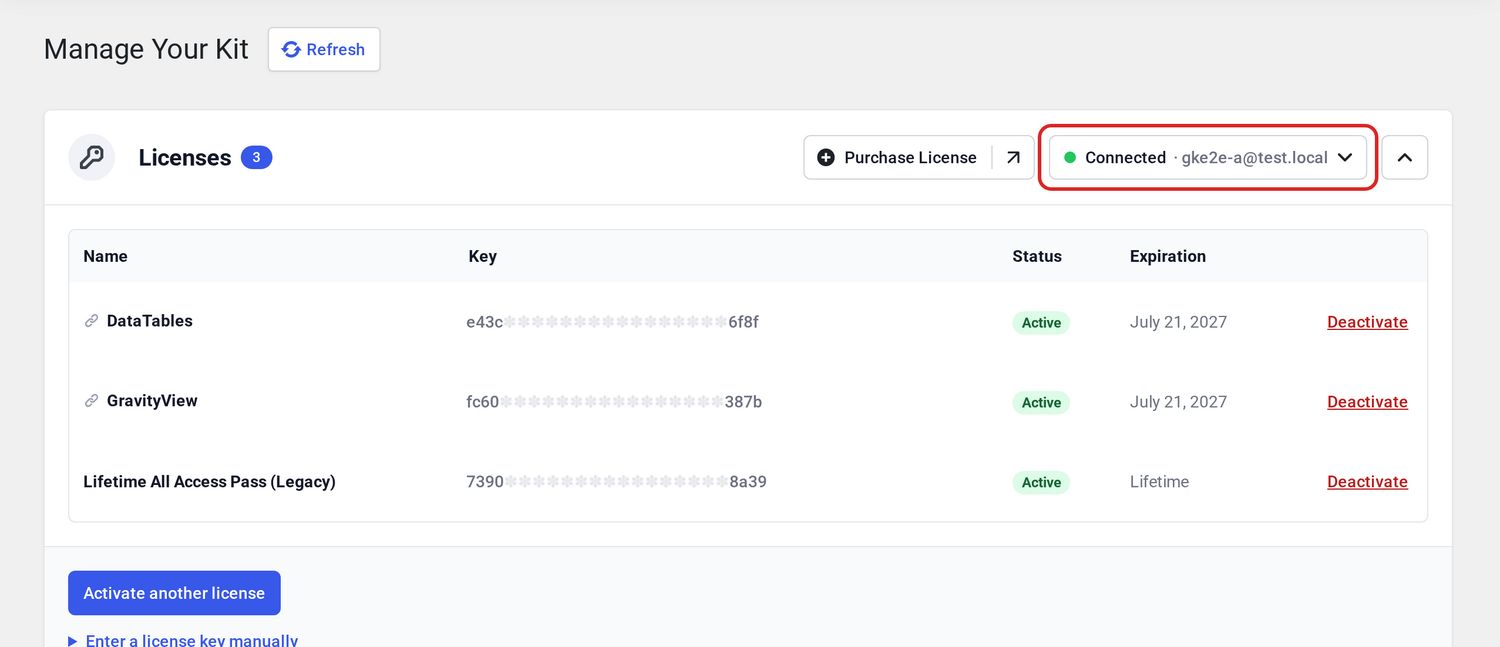
The table lists every license saved on the site with its status. Click Deactivate in a row to deactivate that license on this site. When a license can’t be deactivated here, its row shows the reason instead, such as Your access is view-only or Managed by network admin.
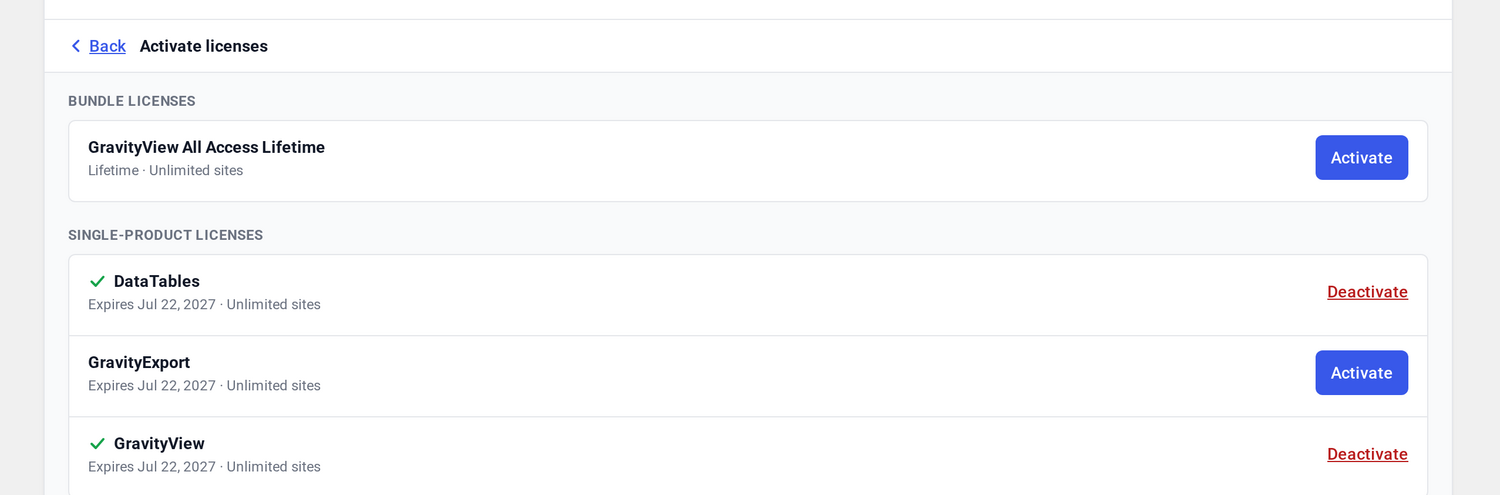
To activate another license from your account, click Activate another license. The list groups your licenses into bundle and single-product licenses, with Activate or Deactivate next to each one. The button appears on sites with Full self-service access while your account has a license that isn’t active on the site. On a site with no license yet, it reads Activate a license….
Enter a license key manually works the same way as on a site that isn’t connected.
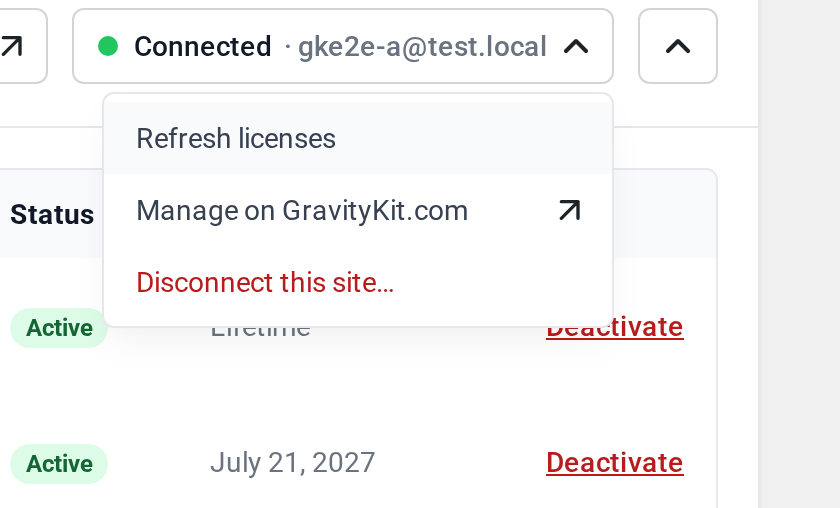
Click Connected to open the connection menu. Refresh licenses loads changes you made in your account, and Manage on GravityKit.com opens your account in a new tab. Disconnect this site… is covered below.
Manage sites from your GravityKit account #
Open Connected Sites in your GravityKit account. The page appears in the account menu once you have connected a site.
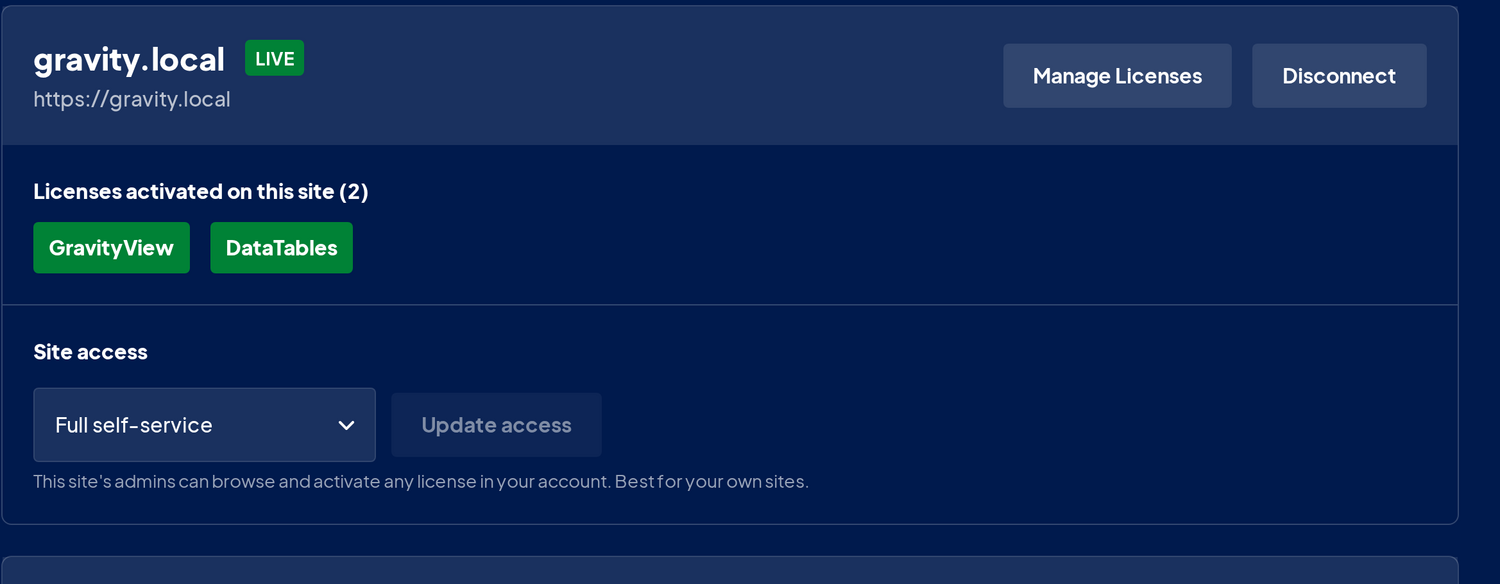
Each site on the Current tab shows its licenses and a status: Live, or Idle when the site hasn’t checked in for 14 days. A network connection also shows Network. To change what the site’s administrators can do, choose a new Site access level on the card and click Update access.
Click Manage Licenses to choose which licenses are active on the site, then click Save licenses.
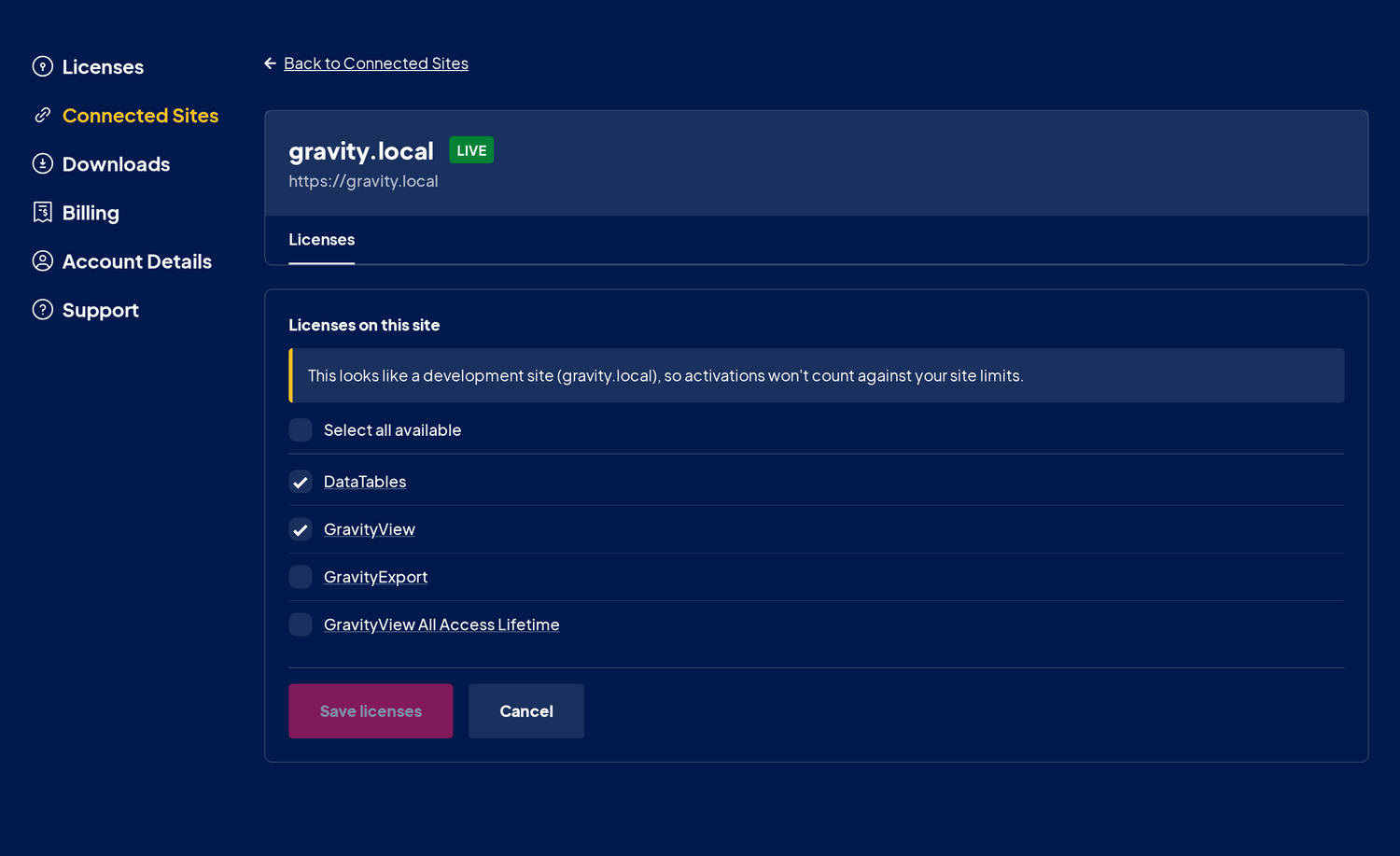
A license marked Allocated, not active is still assigned to the site, but its activation was removed outside the connection. Click Re-activate to activate it again, or Remove access to end the assignment.
Clearing a license and saving deactivates it on the site. Afterwards, a site with Full self-service access can activate the license again from WordPress. With the other access levels, the site can’t add it back through the connection until you select it again here.
Sites you disconnect move to the Past tab. To delete a disconnected site’s record permanently, click Remove for good.
Disconnect a site #
In WordPress, click Connected at the top of the Licenses section, choose Disconnect this site…, and click Disconnect. From your GravityKit account, click Disconnect on the site’s card in Connected Sites and confirm.
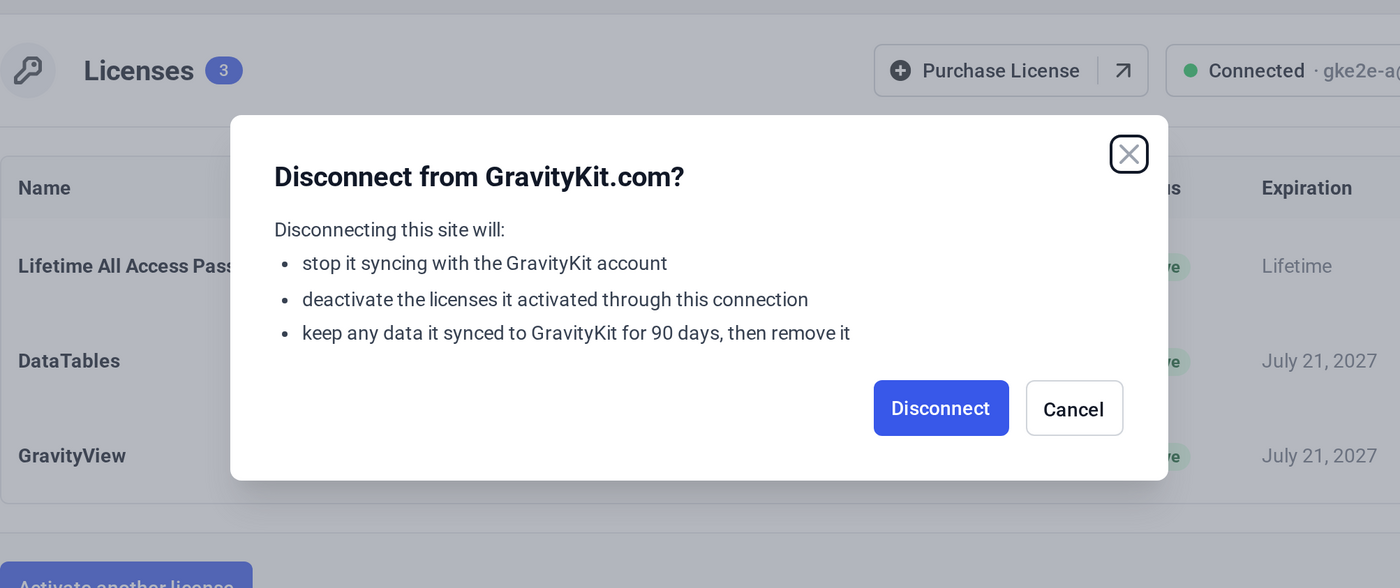
Disconnecting deactivates the licenses the site activated through the connection.
If WordPress can’t confirm the disconnect with GravityKit.com, a message tells you so. The site forgets the connection, but its licenses may stay active: disconnect the site from Connected Sites to deactivate them.
When the connection can no longer be used, the connection menu offers Reconnect and Remove connection… instead. Remove connection makes the site forget the connection and removes the license entries it left behind. In the Reconnect needed state it doesn’t contact GravityKit.com, so also disconnect the site in Connected Sites to free its licenses.
Connection status #
The button at the top of the Licenses section shows the status of the connection.
| Status | What it means | What to do |
|---|---|---|
| Connected | The connection works. | If a change you made in your account isn’t showing yet, choose Refresh licenses in the connection menu. |
| Attention needed | The site hasn’t reached GravityKit.com for at least a day. Licenses that are already active keep working. | Click Retry in the notice. If it keeps failing, check that the site can make outbound HTTPS requests to gravitykit.com. |
| Reconnect needed | The site’s secret keys changed, either the WordPress salts or GRAVITYKIT_SECRET_KEY, so WordPress can no longer read the connection or the saved licenses. | Reconnect the site, as described below. |
| Disconnected | The site was disconnected from your account, or a response from GravityKit.com couldn’t be verified. | Reconnect the site, as described below. |
Reconnect a site #
When the status reads Reconnect needed or Disconnected, the Licenses section shows a notice with a Reconnect button. Reconnect needed appears when the site’s secret keys change, for example when a security plugin or the host changes them, or when a move replaces wp-config.php. The license key keeps disappearing explains the causes and how to prevent them.

- Click Reconnect.
- Sign in to the same GravityKit account.
- Select the licenses the site needs and approve the connection. Licenses still active on the site are already selected.
Reconnecting restores the licenses managed through the connection. After Disconnected, keys you entered by hand are still on the site. After Reconnect needed, the authorization page also selects the keys from this account that are still active on the site, and they come back under the connection if you leave them selected. Enter any other key again.
If you reconnect a site that moved to a new address, the old address stays in Connected Sites with its licenses active. A license at its site limit can’t be selected for the new address until you disconnect the old address there.