Skip to content
GravityKit
Buy
Sign in
0 items
  • Plugins

    GravityKit All Access

    Our complete Kit of essential tools for extending and enhancing Gravity Forms—everything you need to build powerful web apps and workflows.

    Learn more
    • GravityView

      GravityView

      Bestseller

      Display Gravity Forms entries on the front-end of your site and build powerful web applications.

    • GravityImport

      GravityImport

      Trending

      Import entries from CSV files into Gravity Forms to transfer data, create new forms, or update existing entries.

    • GravityEdit

      GravityEdit

      Quickly edit Gravity Forms entries inline to save time, reduce clicks, and streamline your workflow.

    • GravityCharts

      GravityCharts

      Trending

      Turn Gravity Forms entries into interactive charts and graphs.

    • GravityActions

      GravityActions

      Update multiple Gravity Forms entries at once, send bulk emails, and streamline your workflow.

    • GravityCalendar

      GravityCalendar

      Turn Gravity Forms entries into dynamic calendars to showcase events, schedules, appointments, and more.

    • GravityExport

      GravityExport

      Export Gravity Forms entries to Excel, CSV, PDF, or Google Sheets, then share them with secure links or deliver them to cloud storage on a schedule.

    • GravityMath

      GravityMath

      Perform advanced calculations on Gravity Forms entries to display totals, averages, or build custom calculators.

    • GravityRevisions

      GravityRevisions

      Track, compare, and restore changes made to Gravity Forms forms and entries with a full version history.

    • GravityMigrate

      GravityMigrate

      Migrate all Gravity Forms data, including forms, entries, Views, feeds, uploads, and more.

    • GravityBoard

      GravityBoard

      Manage projects with collaborative project management. Coordinate with your team and streamline your workflows.

    • GravitySearch

      GravitySearch

      Search Gravity Forms entries across every form from one screen.

  • Ideal For

    • Nonprofits
    • Web Agencies
    • Education
    • Developers
    • Small Businesses
    • Startups
    Explore All Use Cases

    Case studies

    • West Fork Schools
    • Princeton University
    • BrightLeaf Giving
    • Jacksonville Port Authority
    • National Severe Storms Lab
    • Leadpal
    • Mediebruket
    • Dragonfly
    View All Case Studies
  • Resources

    • Blog
    • Case studies
    • Newsletter
    • GravityKit vs competitors
    • Live Demos
    • Documentation
    • Developer docs
    • GravityKit Academy

    Ultimate guides

    • How to use Gravity Forms
    • Editing Gravity Forms entries
    • Importing Gravity Forms entries
    • Exporting Gravity Forms entries
    • Displaying Gravity Forms entries
    • Gravity Forms conditional logic
    • Gravity Forms calculations
    View More Articles
  • Plugins

    • GravityView

      GravityView

      Bestseller

      Display Gravity Forms entries on the front-end of your site and build powerful web applications.

    • GravityImport

      GravityImport

      Trending

      Import entries from CSV files into Gravity Forms to transfer data, create new forms, or update existing entries.

    • GravityEdit

      GravityEdit

      Quickly edit Gravity Forms entries inline to save time, reduce clicks, and streamline your workflow.

    • GravityCharts

      GravityCharts

      Trending

      Turn Gravity Forms entries into interactive charts and graphs.

    • GravityActions

      GravityActions

      Update multiple Gravity Forms entries at once, send bulk emails, and streamline your workflow.

    • GravityCalendar

      GravityCalendar

      Turn Gravity Forms entries into dynamic calendars to showcase events, schedules, appointments, and more.

    • GravityExport

      GravityExport

      Export Gravity Forms entries to Excel, CSV, PDF, or Google Sheets, then share them with secure links or deliver them to cloud storage on a schedule.

    • GravityMath

      GravityMath

      Perform advanced calculations on Gravity Forms entries to display totals, averages, or build custom calculators.

    • GravityRevisions

      GravityRevisions

      Track, compare, and restore changes made to Gravity Forms forms and entries with a full version history.

    • GravityMigrate

      GravityMigrate

      Migrate all Gravity Forms data, including forms, entries, Views, feeds, uploads, and more.

    • GravityBoard

      GravityBoard

      Manage projects with collaborative project management. Coordinate with your team and streamline your workflows.

    • GravitySearch

      GravitySearch

      Search Gravity Forms entries across every form from one screen.

    View All Products

    GravityKit All Access

    Our complete Kit of essential tools for extending and enhancing Gravity Forms—everything you need to build powerful web apps and workflows.

    Learn more
  • Ideal For

    • Nonprofits
    • Web Agencies
    • Education
    • Developers
    • Small Businesses
    • Startups
    Explore All Use Cases

    Case studies

    • West Fork Schools
    • Princeton University
    • BrightLeaf Giving
    • Jacksonville Port Authority
    • National Severe Storms Lab
    • Leadpal
    • Mediebruket
    • Dragonfly
    View All Case Studies

    How to build...

    • Property Management
    • Product Catalog
    • Fundraising Dashboard
    • Real Estate Directory
    • Document Library
    • Academic Journal
    • Volunteer Management
    • Meal Tracker
    View All Guides
  • Resources

    • Blog
    • Case studies
    • Newsletter
    • GravityKit vs competitors
    • Live Demos
    • Documentation
    • Developer docs
    • GravityKit Academy

    ultimate guides

    • How to use Gravity Forms
    • Editing Gravity Forms entries
    • Importing Gravity Forms entries
    • Exporting Gravity Forms entries
    • Displaying Gravity Forms entries
    • Gravity Forms conditional logic
    • Gravity Forms calculations
    View More Articles
  • Support
  • Pricing
0 items

Search

Results appear automatically as you type.
Loading results…

results found matching

    Sign in
    Buy

    Docs

    • Docs Home

    Gravity Forms Add-Ons

    • GravityView
    • GravityActions
    • GravityBoard
    • GravityCalendar
    • GravityCharts
    • GravityEdit
    • GravityExport
    • GravityImport
    • GravityMath
    • GravityMigrate
    • GravityRevisions
    • GravitySearch
    • GF Widget for Elementor
    • GF Dynamic Lookup
    • GF Entry Tags
    • GF Event Field
    • GravityExport Lite
    • GF Zero Spam

    GravityView

    • Getting Started
    • View Setup
    • FAQ
    • Pre-Sale
    • Advanced
    • Common Problems
    • Customizing Your Views
    • Edit Entry
    • Entry Approval
    • Filter and Sort Results
    • Gravity Forms
    • Merge Tags
    • Roles and Capabilities
    • Search
    • Shortcodes
    • View Settings
    • WordPress Posts

    General Help

    • Account, Invoices, and Billing
    • License Related
    • Plugins and Settings
    • Contact
    • Docs Home
    • Gravity Forms Add-Ons

      • GravityView
      • GravityActions
      • GravityBoard
      • GravityCalendar
      • GravityCharts
      • GravityEdit
      • GravityExport
      • GravityImport
      • GravityMath
      • GravityMigrate
      • GravityRevisions
      • GravitySearch
      • GF Widget for Elementor
      • GF Dynamic Lookup
      • GF Entry Tags
      • GF Event Field
      • GravityExport Lite
      • GF Zero Spam
    • GravityView

      • Getting Started
      • View Setup
      • FAQ
      • Pre-Sale
      • Advanced
      • Common Problems
      • Customizing Your Views
      • Edit Entry
      • Entry Approval
      • Filter and Sort Results
      • Gravity Forms
      • Merge Tags
      • Roles and Capabilities
      • Search
      • Shortcodes
      • View Settings
      • WordPress Posts
    • General Help

      • Account, Invoices, and Billing
      • License Related
      • Plugins and Settings
    • Contact

    GravityImport

    • Importing entries from the command line with WP-CLI
    • “Row #[x] ID does not exist for form” error
    • Adding new fields to an existing form during import
    • Allow for non-standard imported values for checkbox fields
    • Bulk Edit Step: What are these fields?
    • Bulk Edit Step: What will happen to my old field data?
    • Can I import a CSV file on the front-end of my website?
    • Can I import passwords with the GravityImport plugin?
    • Capabilities necessary to import entries
    • Choosing a form for the import
    • Configure import options
    • Continue Processing If Errors Occur
    • Create a new form in Gravity Forms from a CSV
    • Does GravityImport limit the number of entries I can import?
    • Does GravityImport process calculations during import?
    • Does GravityImport support importing Nested Form fields?
    • Error: Arguments not allowed here: rest_route
    • Error: CSV file failed to upload
    • Error: Import has finished with errors – HTTP 404
    • Error: Server returned an empty response
    • Exporting a CSV from Apple Numbers
    • Exporting a CSV from Google Sheets
    • Exporting a CSV from LibreOffice
    • Exporting a CSV from Microsoft Excel
    • Exporting List fields as JSON
    • Formatting dates for Gravity Forms in Microsoft Excel
    • Getting started with GravityImport: how to import entries into Gravity Forms

    • GravityImport Developer Hooks
    • GravityImport Support for Gravity Forms Add-Ons
    • GravityImport: “The importer encountered an error that prevents it from continuing”
    • How to assign entries to users during import
    • How to change the CSV delimiter
    • How to Clean Up GravityImport Database Tables
    • How to enable pre-release versions of GravityImport
    • How to import data from a MySQL database
    • How to restrict access to Import Entries
    • How to trigger notifications for imported entries
    • Import CSV to Gravity Forms with Import Entries 2.0
    • Import Option: Skip Field Validation
    • Import Step: Where would you like to import the entries?
    • Importing dates in UTC timezone
    • Importing Gravity Forms Post Fields from CSV
    • Importing List fields into a new form
    • Importing List fields into existing forms
    • Mapping CSV columns to form fields
    • Naming your field columns
    • Restarting a Gravity Flow workflow after import
    • Updating existing entries with the GravityImport plugin
    • Uploading a CSV file
    • Home
    • Docs
    • GravityImport
    • Getting started with GravityImport: how to import entries into Gravity Forms

    Getting started with GravityImport: how to import entries into Gravity Forms

    Estimated reading: 5 minutes

    Updated on August 27, 2026
    Gravity Forms Certified Add-On badge for the CSV Importer plugin

    GravityImport is the best way to import data into Gravity Forms from a CSV.  #

    We’re the only Gravity Forms Certified Add-On for importing entries from CSV. The easy-to-use interface makes it easy to map & import thousands of entries with data validation, input mapping, and more.

    Buy now! – We guarantee it will save you time!

    Watch the video tutorial #

    This guide walks through a complete import: uploading a CSV, choosing the form the entries belong to, mapping your columns to form fields, configuring how the import runs, and checking the results.

    Before you begin, you’ll need:

    • Gravity Forms and GravityImport installed and activated
    • A CSV (comma-separated values) file whose first row contains your column names. GravityImport imports CSV files only, up to your site’s maximum upload size (shown on the upload screen). If your data lives in a spreadsheet, export it as CSV first (Excel’s “CSV UTF-8” format works well).

    The importer is a five-stage wizard: Select Source, Select Form, Map Fields, Configure, and Import. The progress bar at the top shows where you are, and each completed stage gets a Change link so you can step back at any point.

    1. Open the importer #

    In the WordPress admin, go to Forms, then Import/Export, and click the Import Entries tab.
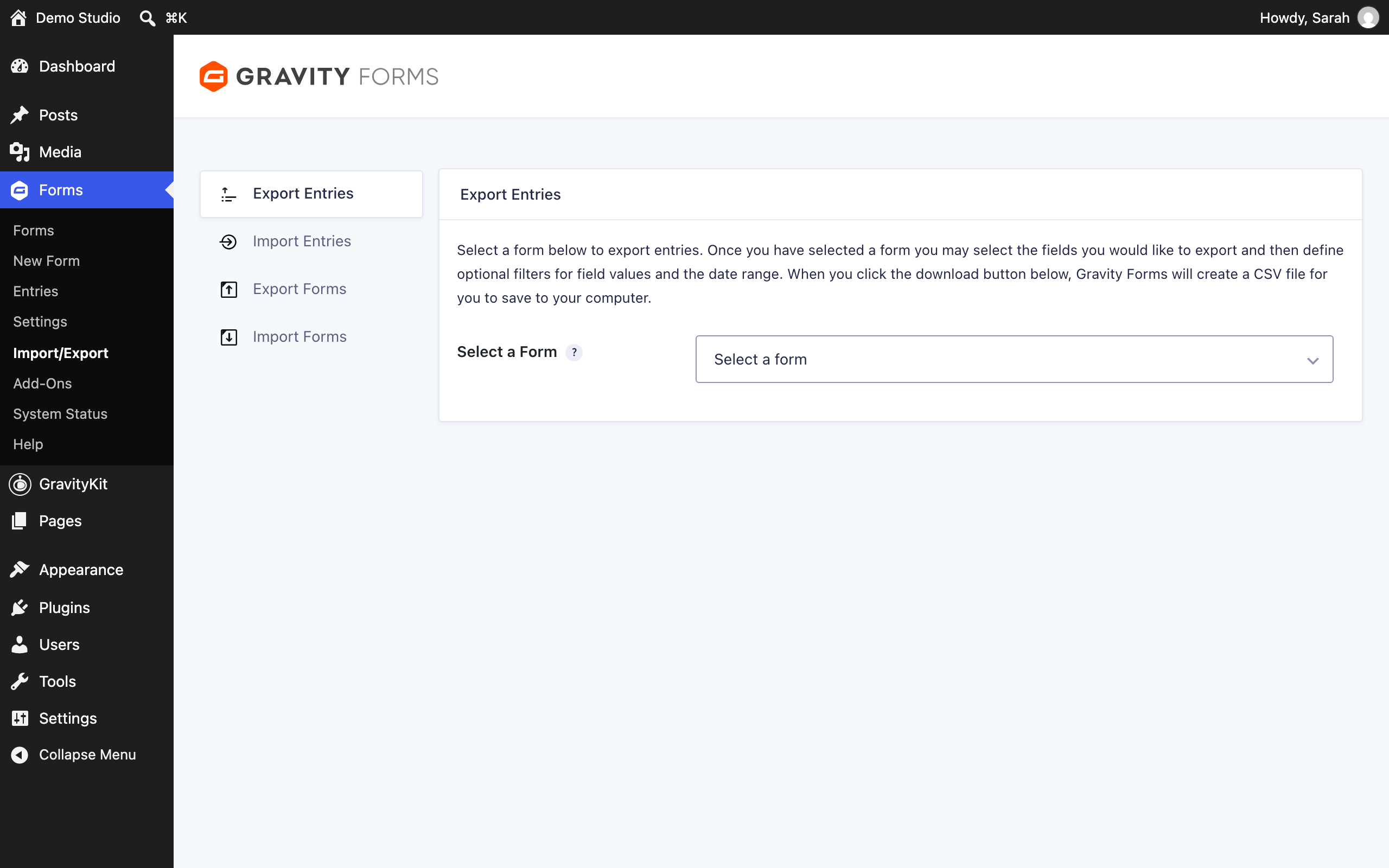
    The Gravity Forms Import/Export page in the WordPress admin. The Forms menu is active in the left sidebar, and the page shows four tabs: Export Entries, Import Entries, Export Forms, and Import Forms, with Export Entries currently selected.

    2. Upload your CSV #

    Drag your CSV onto the drop zone, or click anywhere inside it to choose a file from your computer. Files up to your site’s maximum upload size are accepted; the limit is shown below the drop zone.

    When the upload finishes, the wizard moves to the next stage automatically.
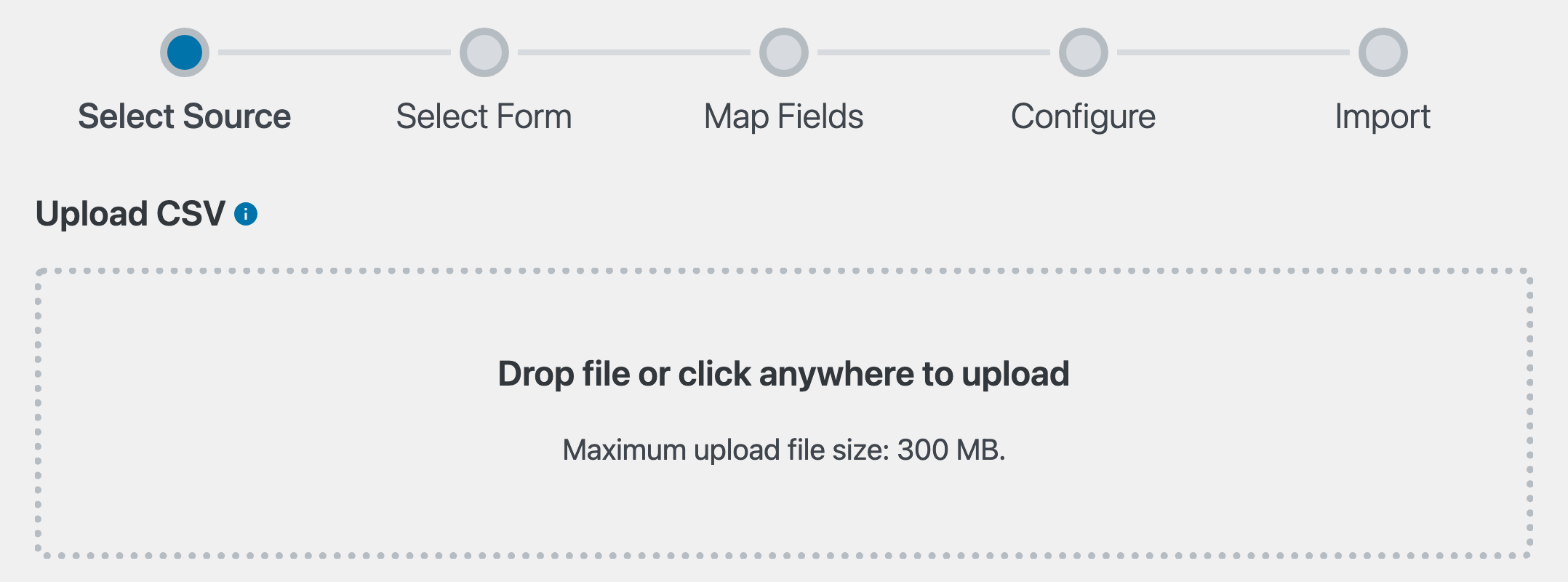
    The Select Source stage of the GravityImport wizard. A dotted drop zone reads "Drop file or click anywhere to upload" with "Maximum upload file size: 300 MB" below it. The progress bar at the top shows five stages: Select Source, Select Form, Map Fields, Configure, and Import.

    3. Choose where the entries go #

    Pick a destination for your rows:

    • An Existing Form adds them as new entries to a form you already have.
    • Create a New Form builds a form for you, with one field per CSV column, and imports into that.
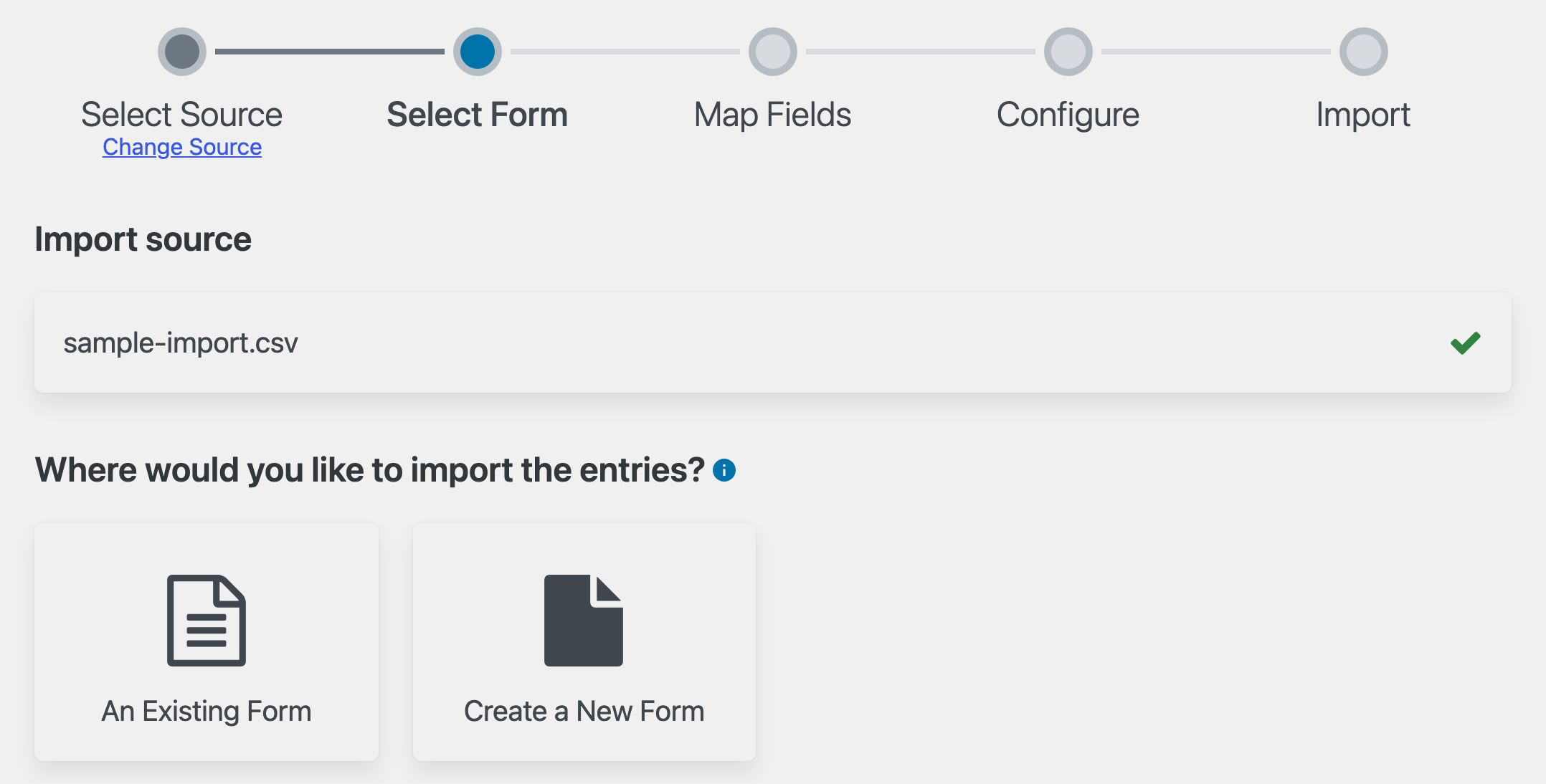
    The Select Form stage. The import source sample-import.csv shows a green check mark. Under "Where would you like to import the entries?" are two tiles: An Existing Form and Create a New Form.

    Importing into an existing form

    Click the form’s name in the list, or type part of its name in the search box to filter. Only active forms are listed, so if you don’t see yours, check that it isn’t inactive or trashed.
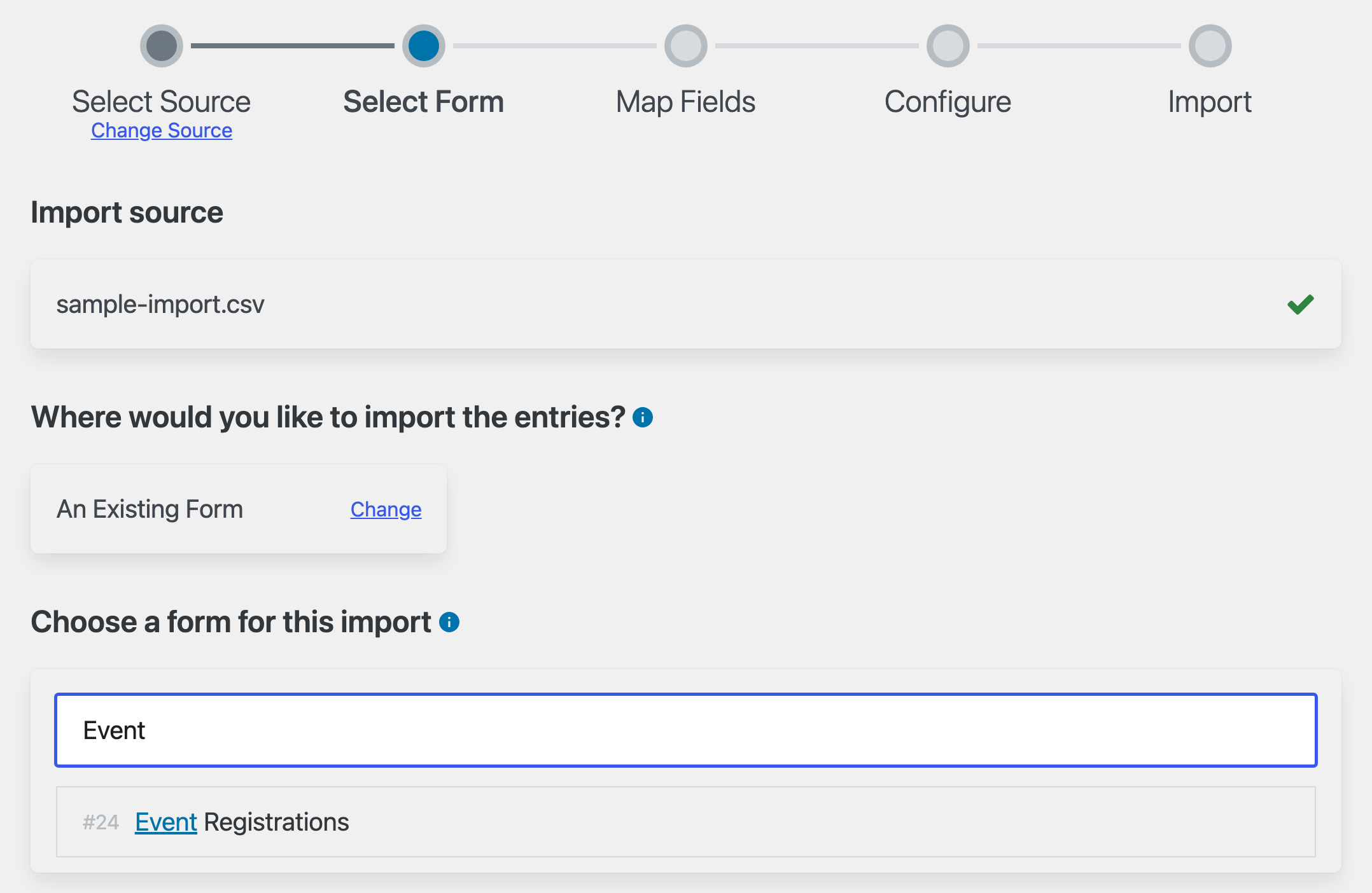
    Choosing a form for the import. "An Existing Form" is selected, and typing "Event" in the search box filters the form list to show form #24, Event Registrations.

    Creating a new form

    Name the new form, then click Continue With Import. GravityImport takes you straight to field mapping, and the form itself is created at the end of the wizard, when you click Create Form and Continue With Import on the Configure stage.
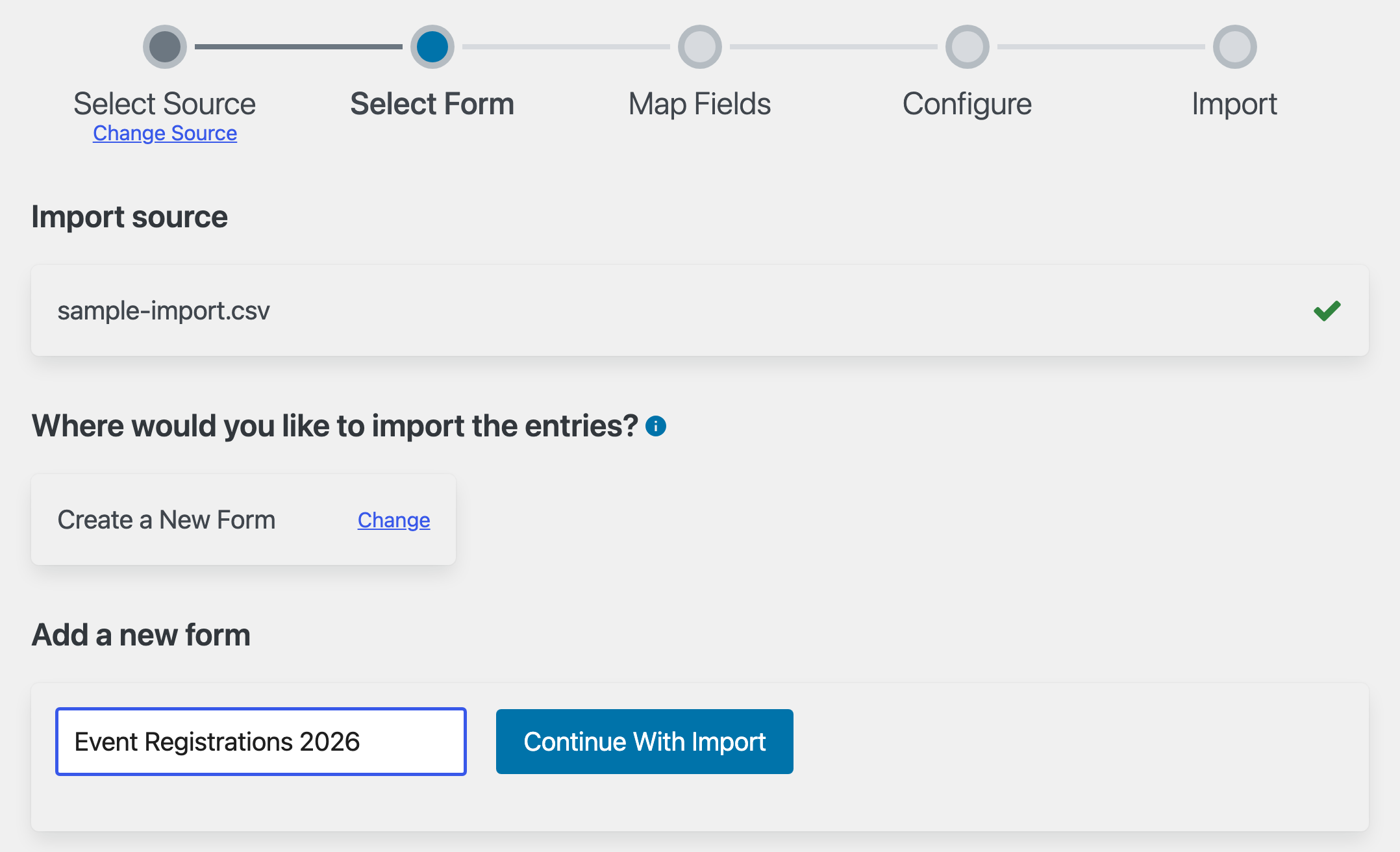
    The Create a New Form option selected on the Select Form stage. The "Add a new form" box contains the name "Event Registrations 2026" next to a Continue With Import button.

    4. Map CSV columns to form fields #

    Each row in the mapping table is one CSV column, with a preview of its first values so you can see what’s in it.

    Columns are mapped for you wherever the column name matches a form field. The match is case-insensitive and checks the field’s label, admin label, and field ID, individual input labels for multi-input fields, and entry properties such as Entry ID or Created By. Clicking Auto-map re-runs this matching at any time.

    For everything else:

    • Pick the field from the column’s dropdown.
    • Choose Add Form Field from the dropdown to create a new field on the form without leaving the importer.
    • Untick a column’s checkbox to leave it out of the import.
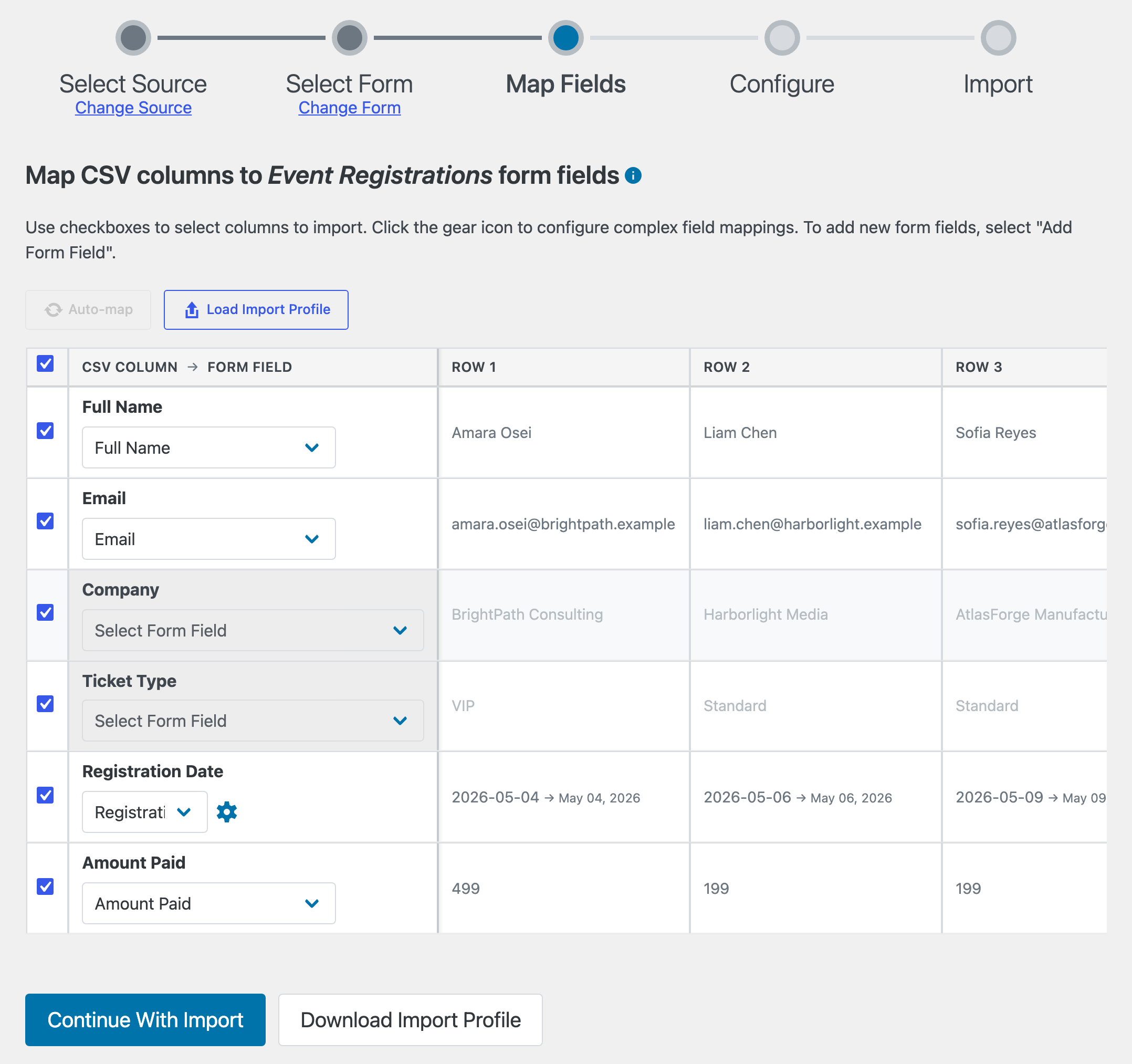
    The Map Fields stage showing the mapping table for the Event Registrations form. Full Name, Email, Registration Date, and Amount Paid are already matched to form fields. Company and Ticket Type still show "Select Form Field" dropdowns. Above the table are Auto-map and Load Import Profile buttons; each row shows preview values from the first three CSV rows.

    A gear icon appears next to columns you can fine-tune. For a date column, for example, it opens a dialog where you confirm or change the date format, with a live preview of how the first value will be interpreted.
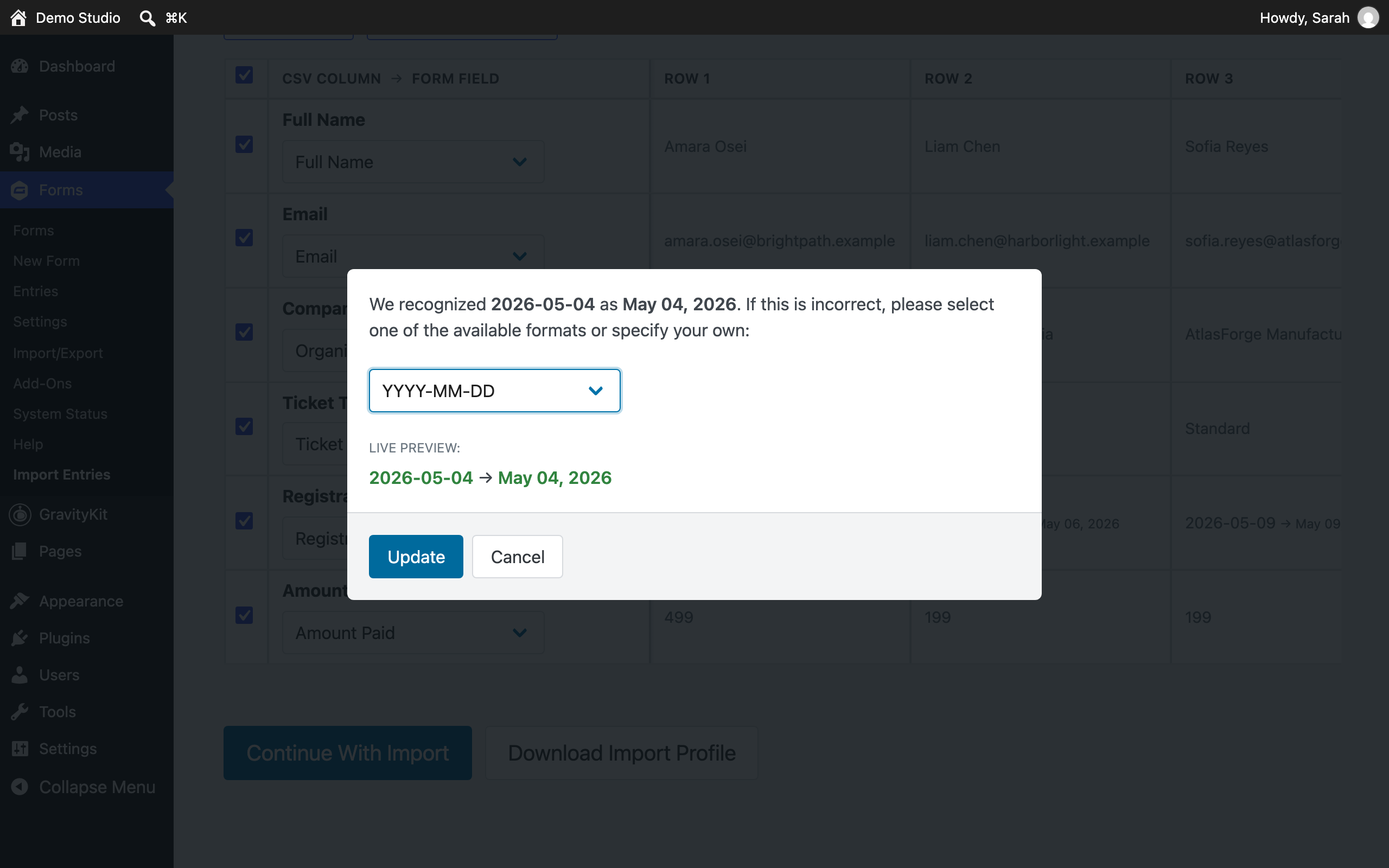
    The date format dialog over a dimmed mapping table. It reads "We recognized 2026-05-04 as May 04, 2026" with a format dropdown set to YYYY-MM-DD, a live preview showing "2026-05-04 → May 04, 2026", and Update and Cancel buttons.

    Running the same import regularly? You can save an import’s field mapping and apply it again instead of re-mapping by hand. Download Import Profile on the Import Complete screen at the end of an import saves one, and Load Import Profile applies it to a later import.

    When the mapping looks right, click Continue With Import.

    5. Configure the import options #

    The Configure stage controls how the import behaves:

    • Ignore Required Form Fields imports rows even when they’re missing values the form normally requires. This toggle only appears when the form has required fields.
    • Continue Processing If Errors Occur (on by default) keeps the import running past problem rows and reports them at the end, instead of stopping at the first error.
    • Conditional Import imports only the rows that match rules you define, such as “Ticket is VIP”.
    • Email Notifications sends the form’s active Gravity Forms notifications for every imported row. Leave this off unless you want an email per entry.
    • Skip Field Validation accepts values the form would normally reject. Gravity Forms still sanitizes certain fields.
    • Process Feeds appears when the form has feeds configured (for example, a User Registration or payment add-on feed) and lets you choose which feeds run for each imported entry.

    If you’re unsure about an option, hover over the Help icon in the lower right of the screen.
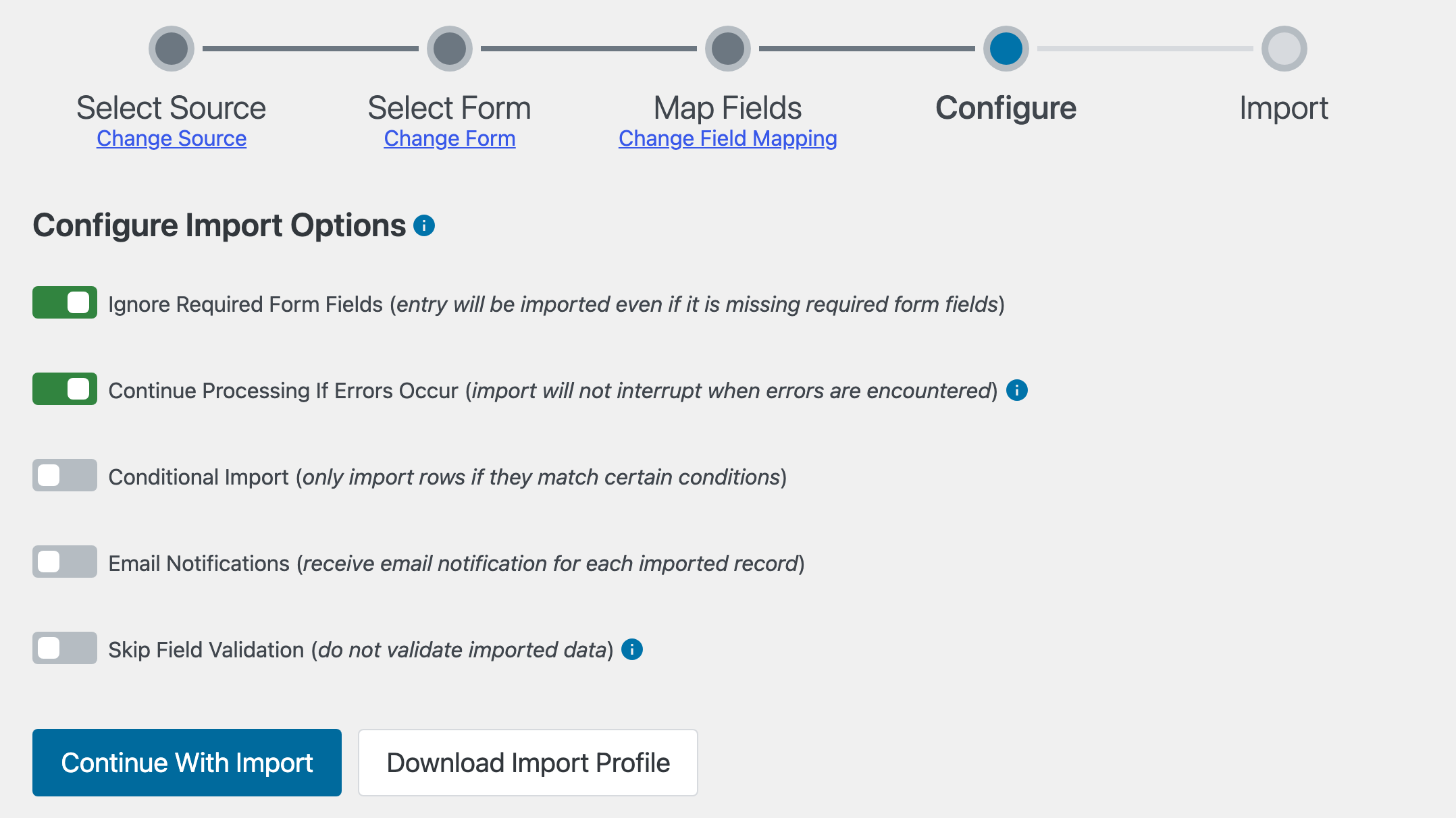
    The Configure Import Options stage listing toggles for Ignore Required Form Fields, Continue Processing If Errors Occur, Conditional Import, Email Notifications, and Skip Field Validation, followed by Continue With Import and Download Import Profile buttons.

    The defaults are fine for a typical first import. Click Continue With Import to start.

    6. Watch the import run #

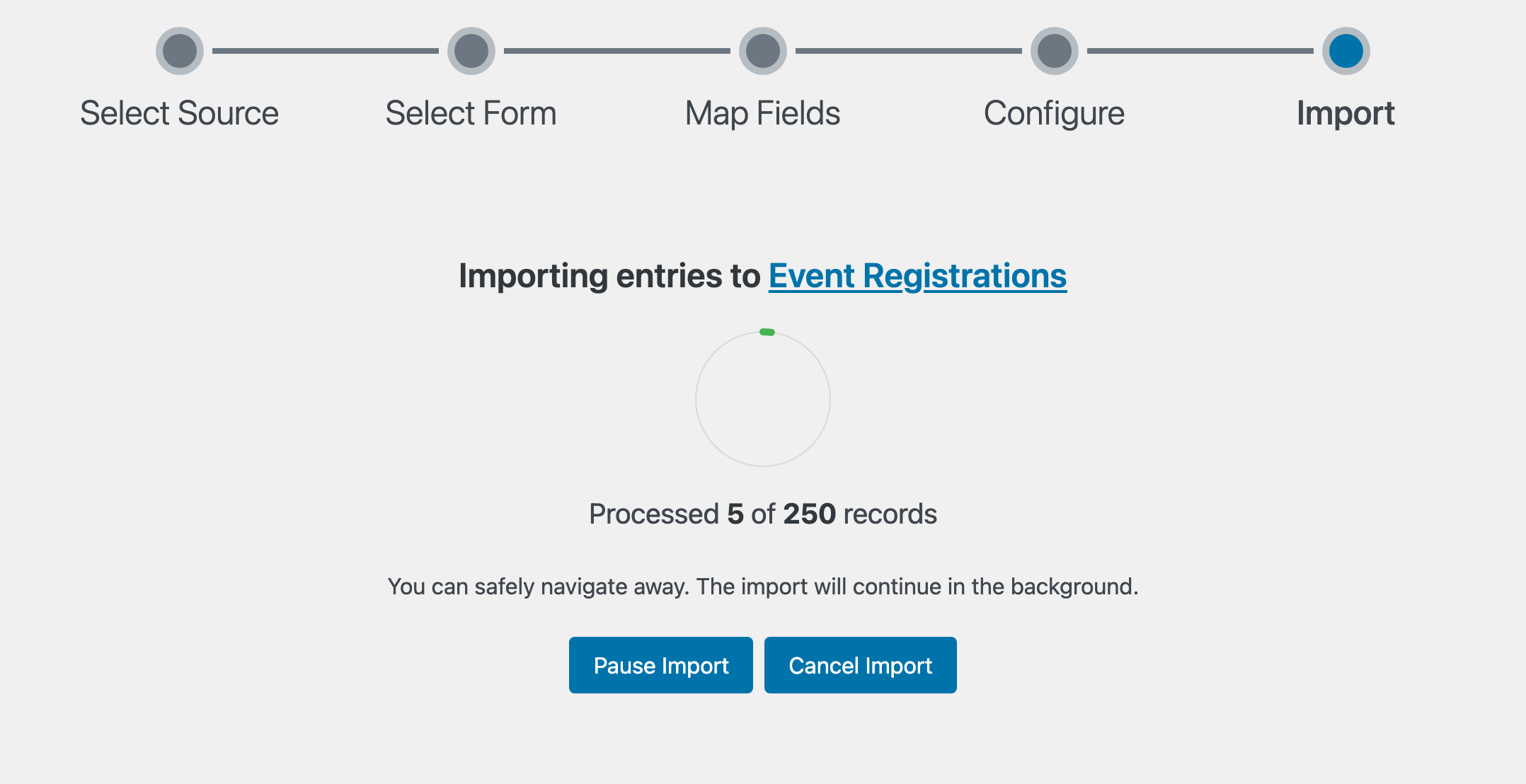
    Rows become entries as the progress updates. You can pause or cancel a running import, and for large files you don’t need to wait around: it’s safe to navigate away, and the import continues in the background.

    The Import stage while importing entries to Event Registrations. A progress ring shows "Processed 5 of 250 records" with the note "You can safely navigate away. The import will continue in the background." and Pause Import and Cancel Import buttons.

    7. Review the results #

    When the import finishes, a summary shows how many rows were imported, skipped, or rejected.
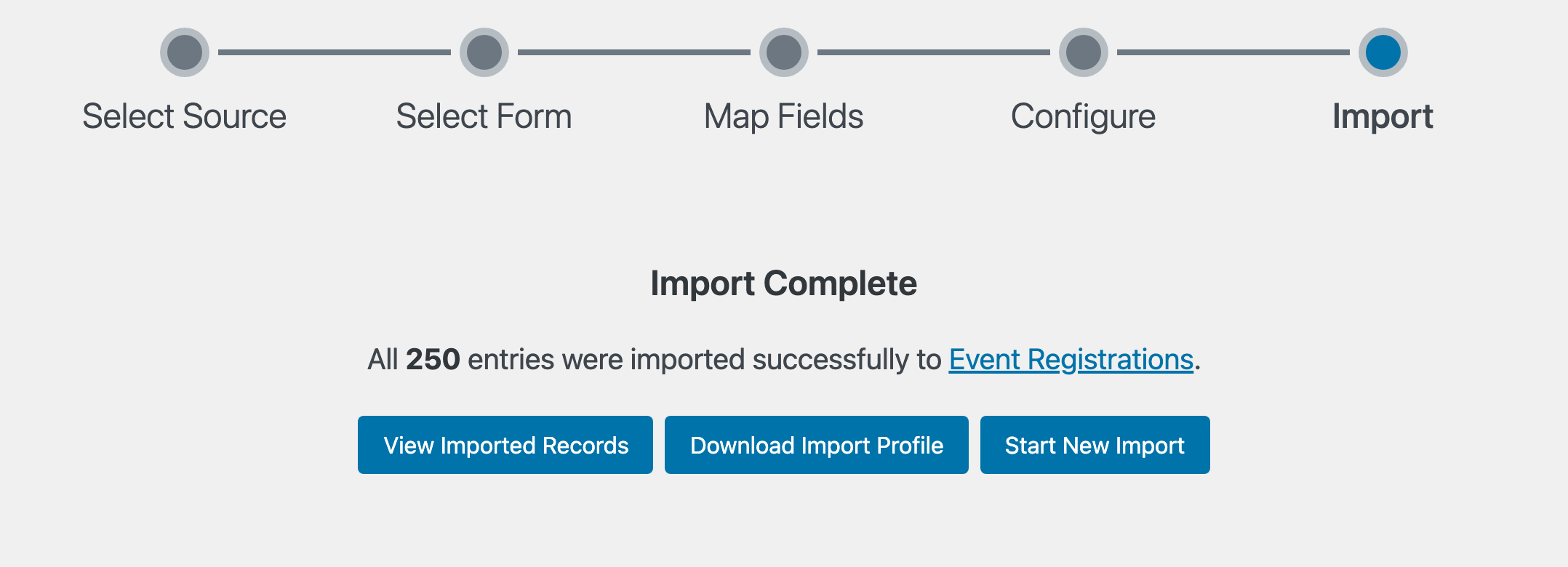
    The Import Complete screen reporting "All 250 entries were imported successfully to Event Registrations" with three buttons: View Imported Records, Download Import Profile, and Start New Import.
    • View Imported Records opens the new entries in Gravity Forms.
    • Download Import Profile saves this import’s field mapping for reuse.
    • Start New Import begins the next file.

    If any rows were rejected, the summary also includes:

    • A view log link explaining why each row failed
    • A download link that saves a file of just the failed rows so you can fix and re-import them
    • Retry Failed Records, which runs the failed rows again, and Remap & Retry Failed Records, which takes you back to field mapping first

    8. View your entries #

    Click View Imported Records to see the imported entries on the Gravity Forms Entries screen, ready to use like any other entries.
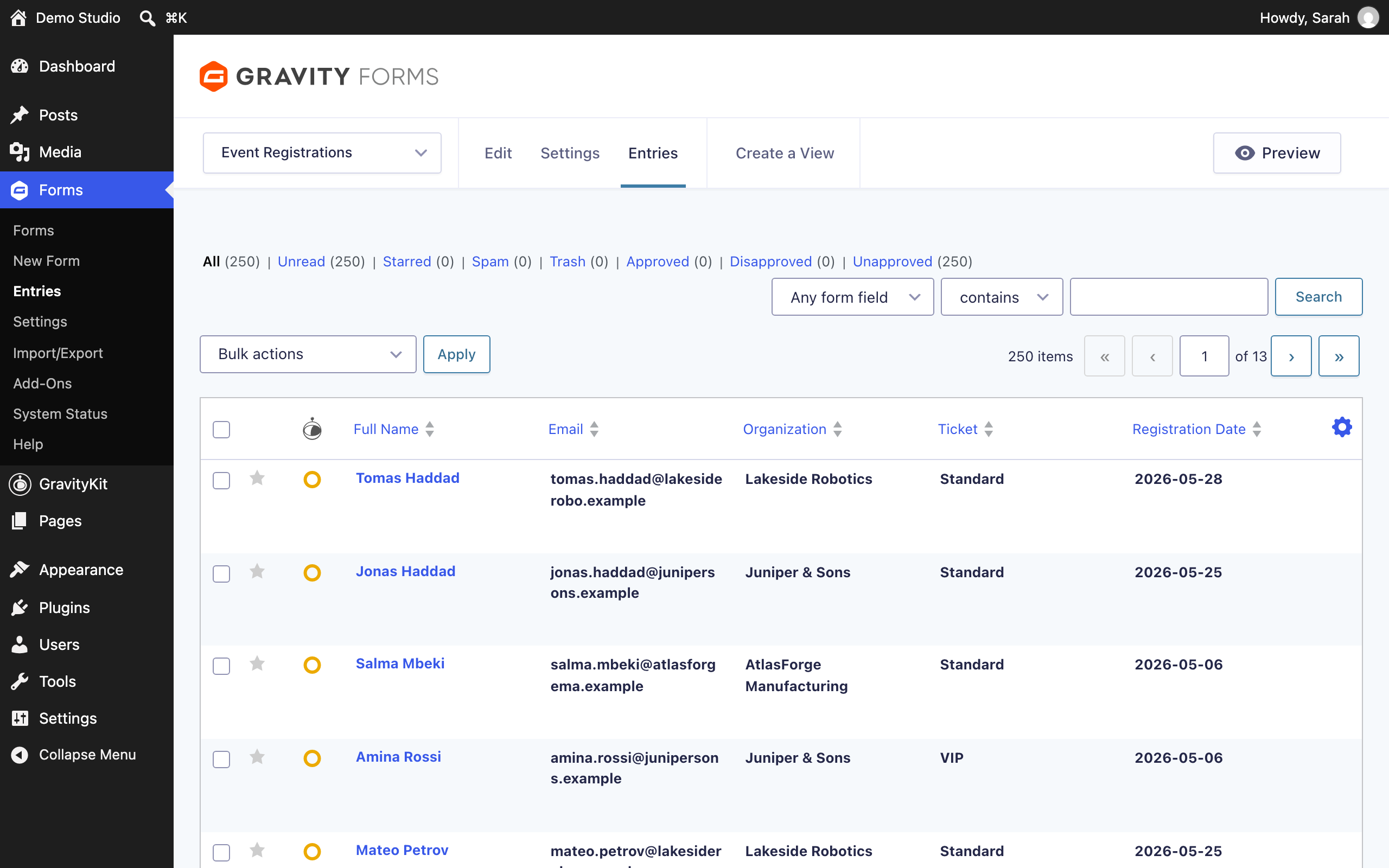
    The Gravity Forms Entries screen for the Event Registrations form showing 250 imported entries with columns for Full Name, Email, Organization, Ticket, and Registration Date.

    What happens if your CSV has errors #

    GravityImport checks your data before the import runs. On the Map Fields stage, columns with invalid values are flagged in the mapping table, and a Validation Error Found panel below it lists each problem with a sample failing value and the number of affected rows. Fix the file and upload it again, untick the problem column, or tick Advanced: Continue with errors to proceed anyway. Rows that fail validation are rejected during the import.
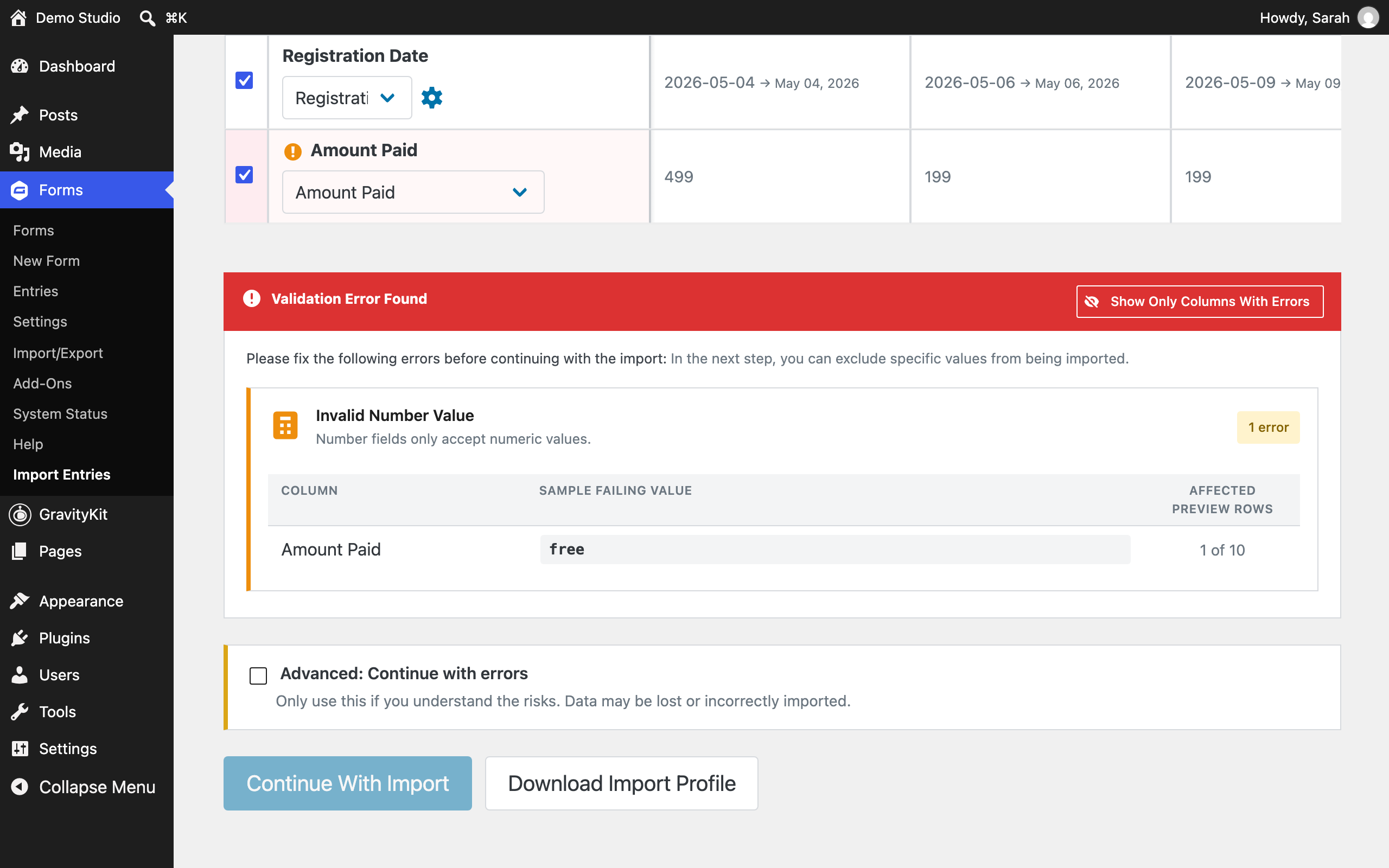
    The Map Fields stage showing the Amount Paid column flagged with a warning icon. Below the mapping table, a red Validation Error Found banner sits above an Invalid Number Value card reading "Number fields only accept numeric values" and a table listing the column Amount Paid, the sample failing value "free", and 1 of 10 affected preview rows. An Advanced: Continue with errors checkbox appears below, and the Continue With Import button is disabled.

    Errors during the run don’t spoil the rest of the import. With Continue Processing If Errors Occur on (the default), GravityImport rejects the problem rows, imports everything else, and reports the results at the end. Turn that option off and the import stops at the first error instead.
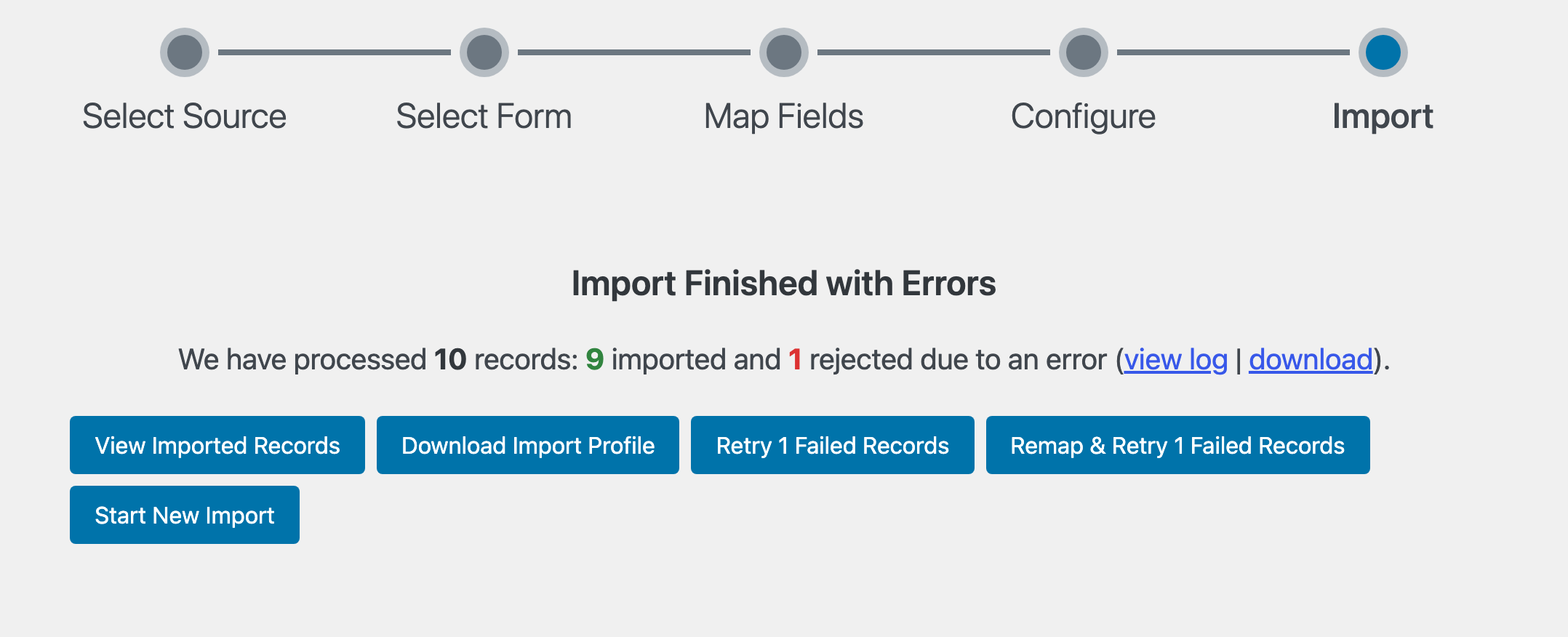
    The Import Finished with Errors screen reading "We have processed 10 records: 9 imported and 1 rejected due to an error" with view log and download links, and buttons for View Imported Records, Download Import Profile, Retry 1 Failed Records, Remap and Retry 1 Failed Records, and Start New Import.

    From the summary you can:

    • Click view log to see why each row failed.
    • Click download to save a file containing only the failed rows.
    • Click Retry Failed Records to run the failed rows again, or Remap & Retry Failed Records to adjust the field mapping first.

    If the flagged values are intentional, the Skip Field Validation and Ignore Required Form Fields options on the Configure stage let them through. Gravity Forms still sanitizes certain fields.

    Updating existing entries #

    Need to bulk-update entries you already have? Re-import a CSV that includes an Entry ID column and GravityImport updates those entries instead of creating duplicates. See Updating existing entries with the GravityImport plugin.

    Related articles #

    • Map CSV columns to form fields
    • Configure import options
    • Naming your field columns
    • Does GravityImport limit the number of entries I can import?
    • Create a new form in Gravity Forms from a CSV
    Still stuck? How can we help?

    How can we help?

    "*" indicates required fields

    This field is for validation purposes and should be left unchanged.
    Replies will go to this email.
    How can we help?*
    My pre-sale question is related to...*
    My WordPress skills are....*
    My Gravity Forms skills are...*
    You will be shown articles from our documentation.
    Vous pouvez nous écrire dans votre langue maternelle si c’est plus facile pour vous—nous nous occuperons de la traduction!
    Puedes escribirnos en tu idioma nativo si te resulta más fácil; ¡nosotros nos encargamos de la traducción!
    Sie können uns in Ihrer Muttersprache schreiben, wenn das für Sie einfacher ist – wir kümmern uns um die Übersetzung!
    U kunt ons in uw moedertaal schrijven als dat gemakkelijker voor u is — wij zorgen voor de vertaling!
    Du kan skrive til oss på ditt morsmål hvis det er enklere for deg — vi tar oss av oversettelsen!
    Du kan skriva till oss på ditt modersmål om det är lättare för dig — vi tar hand om översättningen!
    Você pode nos escrever em seu idioma nativo se for mais fácil para você — nós cuidaremos da tradução!
    Puoi scriverci nella tua lingua madre se ti è più facile — penseremo noi alla traduzione!
    Please provide as much detail as you're able; this helps us provide you with faster support.
    Drop files here or
    Accepted file types: jpg, jpeg, gif, png, tiff, pdf, bmp, zip, json, csv, xls, xlsx, Max. file size: 256 MB.
      Get better at Gravity Forms every Friday

      Was this page helpful?

      Table Of Contents
      • GravityImport is the best way to import data into Gravity Forms from a CSV. 
      • Watch the video tutorial
      • 1. Open the importer
      • 2. Upload your CSV
      • 3. Choose where the entries go
      • 4. Map CSV columns to form fields
      • 5. Configure the import options
      • 6. Watch the import run
      • 7. Review the results
      • 8. View your entries
      • What happens if your CSV has errors
      • Updating existing entries
      • Related articles
      GravityKit
      • How to Build It
      • GravityKit vs competitors
      • Pricing
      • Products
      • Our Team
      • Our Values
      • Work With Us
      • Coupons
      Support
      • Support
      • Contact
      • Documentation
      • Scope of Support
      • Brand Guidelines
      • Privacy Policy
      • Terms of Service (“Terms”)
      I am a...
      • Nonprofit
      • Web agency
      • Small business owner
      • Web developer
      • Educational institution
      • WordPress freelancer
      • Startup founder
      • One-person agency
      Get notified of updates.

      We’re constantly improving GravityKit. Fill out your email below and we’ll notify you anytime major updates drop.

      • Facebook
      • Twitter
      • Mastodon
      GravityKit is a Gravity Forms Certified Developer.

      Copyright © 2026, Katz Web Services, Inc.

      GravityKit and GravityView are registered trademarks of Katz Web Services, Inc.