
Published
•
Updated
WordPress form plugin market share 2026: CF7, Gravity Forms, and more
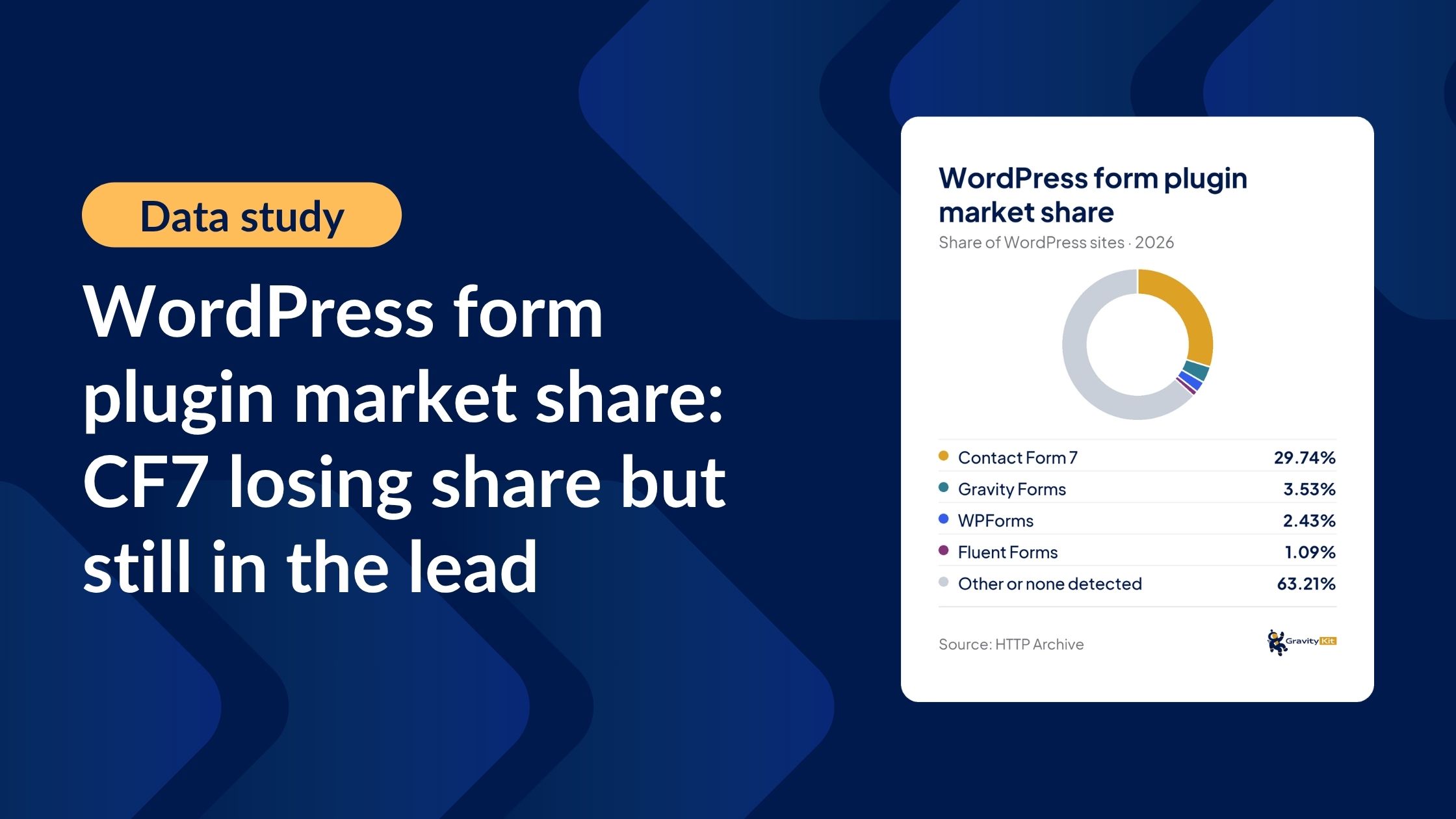
Contact Form 7 is on 29.74% of WordPress sites, Gravity Forms on 3.53%, WPForms on 2.43%. HTTP Archive data on the most used WordPress form plugins in 2026, with year-over-year change and Fluent Forms measured for the first time.

In our WordPress market share study we used the HTTP Archive dataset to track the growth and decline of the major CMSes. Our page builder study then zoomed into how WordPress sites are built. This piece zooms in again, on the form plugins WordPress sites are actually running.
As of July 2026, Contact Form 7 is detected on 29.74% of WordPress sites in HTTP Archive’s sample. Gravity Forms is next at 3.53%, then WPForms at 2.43%, Fluent Forms at 1.09%, Formidable Forms at 0.88% and Ninja Forms at 0.45%. Every plugin with a year of history lost detected sites over the past twelve months. Gravity Forms lost the fewest, and it is the only one whose share of WordPress sites went up.
The numbers below come from the HTTP Archive Tech Report API and reflect the July 2026 crawl. Because form plugins are a WordPress-centric category, we use share of WordPress sites as the primary metric throughout.
Two things to know before the numbers. First, HTTP Archive only runs detection on the homepage and one other interior page of each site, so plugins that only load their assets on pages with a form are under-counted, and these are floors, not censuses. Second, a site can run more than one form plugin, so the shares overlap and don’t add up to a “form plugin market.” Ranking and direction are the reliable signals here; the absolute counts are not. More on both at the end.
Part of our WordPress data studies series: original research on the state of WordPress, refreshed each quarter.
Where Contact Form 7 stands today
As of July 2026, Contact Form 7 is detected on 29.74% of WordPress sites in the sample, roughly three and a half times the other five plugins in this study combined (8.38%). The next plugin, Gravity Forms, sits at 3.53%.
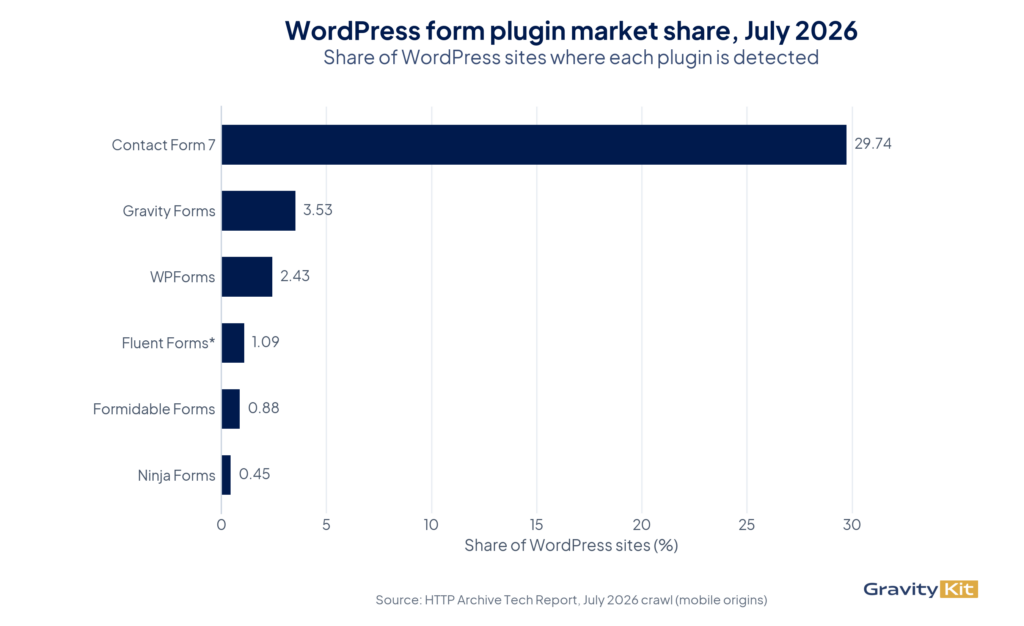
Top WordPress form plugins by share
| Rank | Form plugin | Share of WP sites | YoY Δ (pp) | YoY detected sites | Share of measurable web |
|---|---|---|---|---|---|
| 1 | Contact Form 7 | 29.74% | −1.70 | −13.6% | 9.45% |
| 2 | Gravity Forms | 3.53% | +0.05 | −7.3% | 1.12% |
| 3 | WPForms | 2.43% | −0.26 | −17.4% | 0.77% |
| 4 | Fluent Forms* | 1.09% | n/a | n/a | 0.35% |
| 5 | Formidable Forms | 0.88% | −0.02 | −10.3% | 0.28% |
| 6 | Ninja Forms | 0.45% | −0.03 | −15.3% | 0.14% |
*Fluent Forms was added to HTTP Archive’s detection library in the July 2026 crawl, so it has one data point and no year-over-year figures. See the methodology.
Of the five plugins with a year of history, one gained share of WordPress sites over the past year: Gravity Forms (+0.05 pp). Four lost share: Contact Form 7 (−1.70 pp), WPForms (−0.26 pp), Ninja Forms (−0.03 pp) and Formidable Forms (−0.02 pp).
The “YoY detected sites” column tells a harsher story than the share column, and the gap between them is the WordPress denominator: HTTP Archive measured 8.7% fewer WordPress sites in July 2026 than in July 2025. A plugin can lose sites in absolute terms and still hold or gain share if it loses them more slowly than WordPress as a whole.
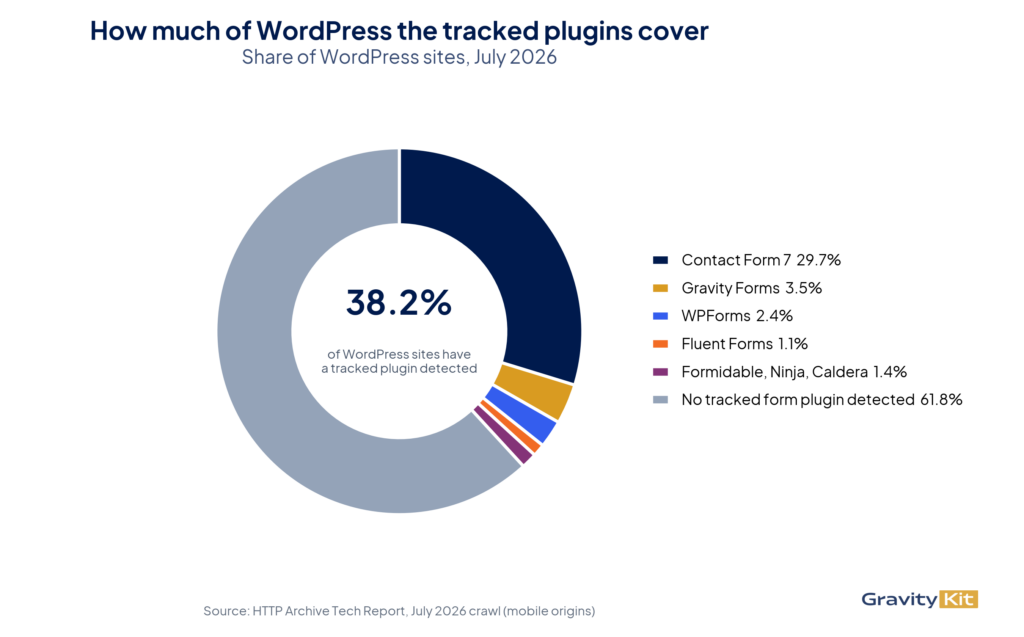
How much of WordPress these plugins cover
Adding the six plugins above (plus Caldera Forms, covered later) gives 38.2% of WordPress sites with a tracked form plugin detected on the homepage and/or another interior page. The remaining 61.8% is not “sites without a form plugin.” It is a mix of plugins HTTP Archive can’t see (Forminator, SureForms, Elementor’s form widget and others), sites whose form plugin loads assets only on the contact page, and sites with no form at all. Because detections can overlap, that gray slice is a floor.
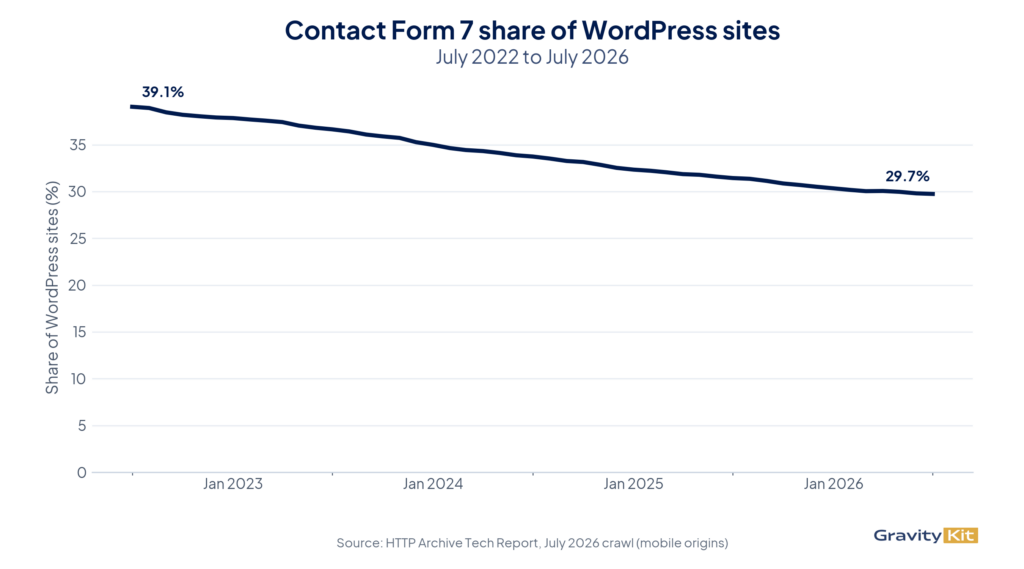
How Contact Forms 7 has moved over time
Contact Form 7’s share of WordPress sites has fallen every year since HTTP Archive began detecting it: from 39.06% in July 2022 to 33.74% in July 2024, 31.44% in July 2025 and 29.74% in July 2026. That is a loss of about a quarter of its share in four years, at a fairly steady 5 to 8% per year on a share basis.
How the remaining plugins have moved over time
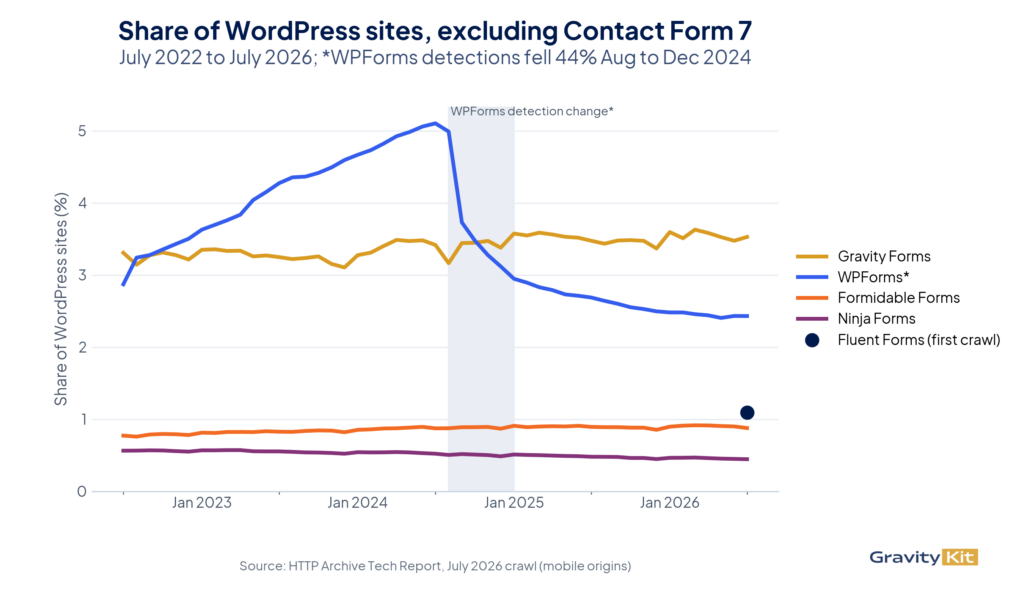
- Gravity Forms – Drifted upward from 3.31% of WordPress sites in July 2022 to 3.42% in July 2024, 3.48% in July 2025 and 3.53% in July 2026, with a high of 3.63% in March 2026. It is one of only two plugins in this study whose July 2026 share is above its July 2022 share (Formidable Forms is the other), and the only one that gained share over the past twelve months.
- WPForms* – Detected on 2.87% of WordPress sites in July 2022, rising to 5.10% in July 2024, then falling to 2.95% by January 2025 and 2.43% in July 2026. The August to December 2024 drop is far steeper than anything else in this dataset (detected sites fell 44% between July and December 2024) and is more consistent with a change in how the plugin is detected than with a sudden loss of users. We show the data as measured and discuss it under “A note on detection and reliability.”
- Formidable Forms – Essentially flat: 0.77% in July 2022, 0.87% in July 2024, 0.88% in July 2026, with a high of 0.92% in March 2026.
- Ninja Forms – A slow, steady decline from 0.56% of WordPress sites in July 2022 to 0.45% in July 2026.
- Fluent Forms – One data point: 1.09% of WordPress sites in July 2026, enough to enter the ranking at number four, ahead of Formidable Forms and Ninja Forms.
Growth rate over time
Measured as year-over-year change in share of WordPress sites, the picture is consistent across three years:
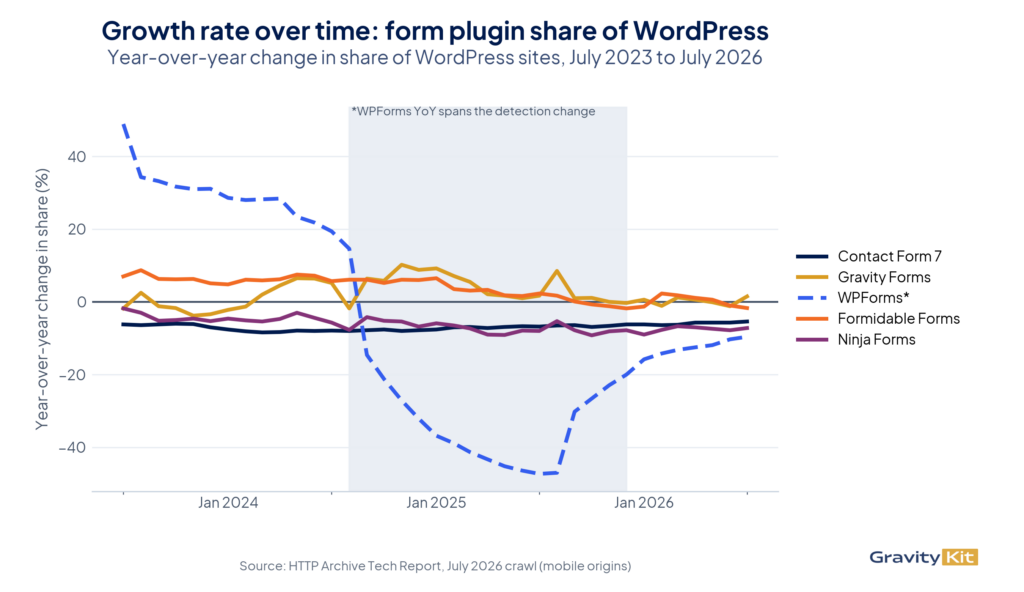
- Contact Form 7 has been between −5% and −8.5% every month for three years, and was −5.4% for the twelve months ending July 2026, its mildest reading in the window.
- Ninja Forms has been negative throughout, mostly between −5% and −9%, currently −7.2%.
- Gravity Forms and Formidable Forms spent 2024 and early 2025 in positive territory (Gravity Forms peaked at +10.2% in November 2024, Formidable Forms at +8.7% in August 2023) and have since drifted back toward flat: +1.5% and −1.7% respectively in July 2026.
- WPForms* swings from +49% to −47% and back to −9.6%. This swing may be the result of a detection change. Its July 2026 figure (−9.6%) is measured entirely after the change.
Year-over-year change, July 2025 to July 2026
Ranked by change in share of WordPress sites over the past twelve months:
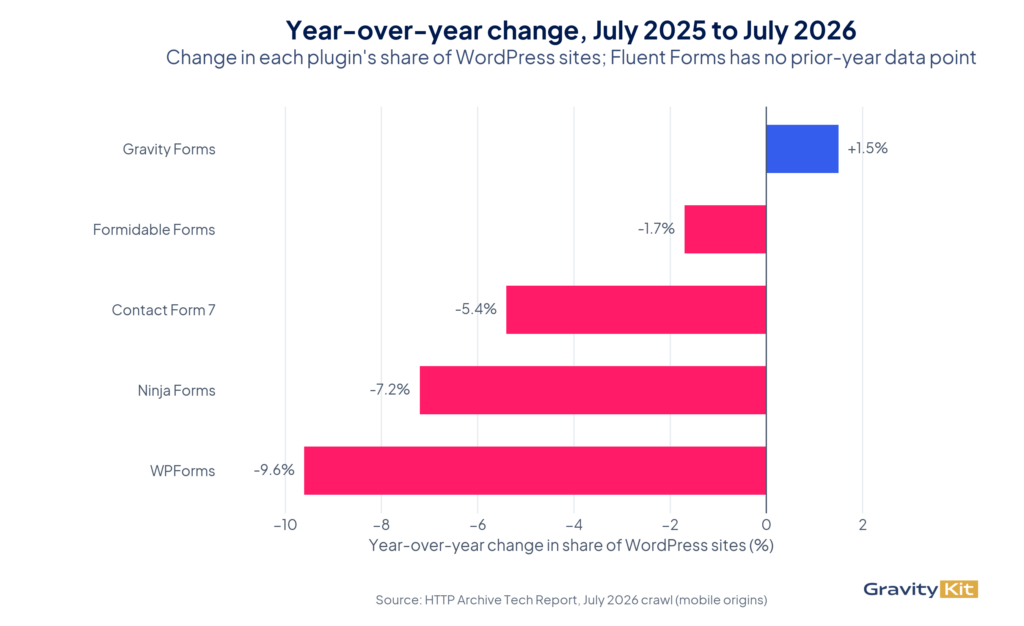
One up, four down. Fluent Forms is absent because it has no July 2025 data point. On the harsher measure, detected sites rather than share, every plugin lost ground: Gravity Forms −7.3%, Formidable Forms −10.3%, Contact Form 7 −13.6%, Ninja Forms −15.3%, WPForms −17.4%. Gravity Forms lost the fewest sites and, because WordPress itself shrank 8.7% in the sample, ended the year with a slightly larger share than it started with.
Fluent Forms: newly visible
Fluent Forms is the one genuinely new thing in this dataset. HTTP Archive’s detection library did not recognize it until the July 2026 crawl (when we submitted a PR to the detector to include it). On its first appearance it is detected on 30,824 WordPress sites, or 1.09%, placing it fourth behind Contact Form 7, Gravity Forms and WPForms.
What plugin death looks like
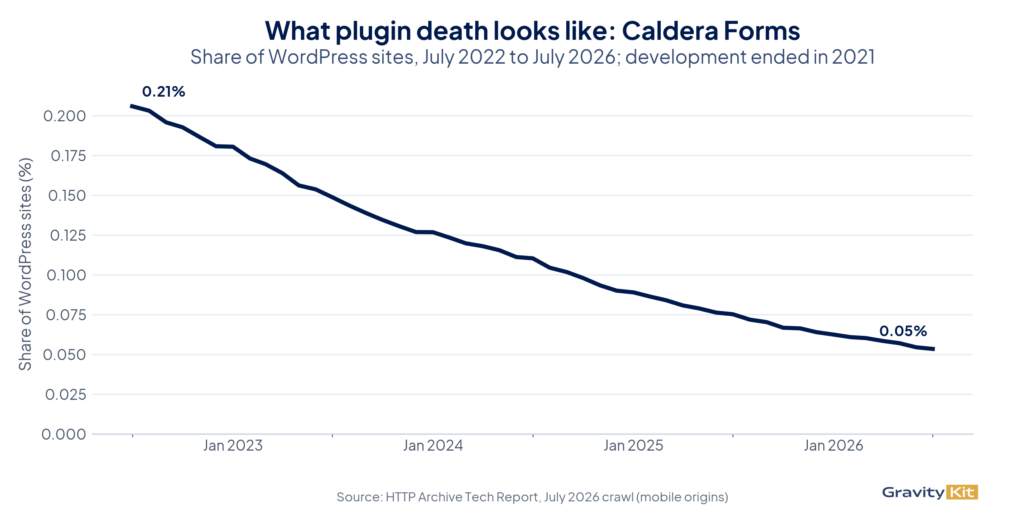
Caldera Forms reached end of life at the end of 2021. HTTP Archive still detects it on 1,509 WordPress sites in July 2026, down from 0.21% of WordPress sites in July 2022 to 0.05%, a loss of about three-quarters of its share in four years.
As a share of the measurable web
For comparison, dividing each plugin’s detected sites by the total mobile origin sample (~8.9M in July 2026) gives a share of the whole measurable web rather than a share of WordPress alone:
| Form plugin | Share of measurable web |
|---|---|
| Contact Form 7 | ~9.5% |
| Gravity Forms | ~1.1% |
| WPForms | ~0.8% |
| Fluent Forms | ~0.3% |
| Formidable Forms | ~0.3% |
| Ninja Forms | ~0.1% |
The web-basis numbers are roughly one-third the size of the share-of-WordPress numbers because WordPress accounts for about 32% of the measurable web in this crawl.
What’s not in this study
- Hosted and non-WordPress form tools that HTTP Archive does detect. HTTP Archive’s “Form builders” category also contains Klaviyo Forms (21,406 sites), Alia, HulkApps Form Builder, Globo Form Builder, Digioh, Google Forms, FormAssembly, Netlify Forms, Marketo Forms and a handful of very small builders. They are hosted embeds or Shopify apps rather than WordPress plugins, so we left them out.
- WordPress form plugins that HTTP Archive cannot detect. Forminator, SureForms, Everest Forms, MetForm, JetFormBuilder, weForms, Happyforms, Quform, WS Form and Kali Forms have no fingerprint in HTTP Archive’s detection library, and hosted builders like Jotform, Tripetto and Cognito Forms are not detected when embedded. Typeform is detected, but HTTP Archive classifies it as a survey tool rather than a form builder and there is no way to isolate its WordPress installs, so it sits outside this study too. Elementor’s built-in form widget is not separately detectable either, which matters given Elementor’s reach. All of these are inside the “no tracked form plugin detected” slice above. We confirmed the list by sweeping every technology in the July 2026 dataset; the six plugins in this study plus Caldera Forms are the complete set of WordPress form builders it can see.
This is also why our numbers differ from install counts on WordPress.org and from commercial technology trackers. Those measure different things (activations reported by the plugin, or detections across a different sample of pages) and can’t be mixed with these figures. We use one source, HTTP Archive, and publish only what it can measure.
Methodology
- Data source – HTTP Archive Tech Report API, July 2026 crawl.
- Sample – Mobile origins in the Chrome UX Report (~8.9M sites in July 2026).
- WordPress denominator – ~2.8M WordPress mobile origins in July 2026, from the same crawl.
- Detection – HTTP Archive’s Wappalyzer fork, “Form builders” category, WordPress plugins only, homepage detection.
- Tracked plugins – Every WordPress form plugin in the category with at least 5,000 detected mobile origins: Contact Form 7, Gravity Forms, WPForms, Fluent Forms, Formidable Forms and Ninja Forms. Caldera Forms (1,509 origins) is shown separately as a retired plugin.
- Share of WordPress sites – Plugin mobile origins divided by WordPress mobile origins, same month.
- Share of measurable web – Plugin mobile origins divided by
technology=ALLmobile origins, same month. - YoY – July 2026 vs. July 2025, same month one year apart. Share-basis growth rates are the percentage change in share of WordPress sites; “detected sites” changes are raw origin counts and are labeled as such.
- Time series – Start July 2022, after HTTP Archive’s mid-2022 crawl-size change and the first full months of Contact Form 7 detection. Single-month collapses below 75% of neighboring months are interpolated in the chart series only (one such month: Gravity Forms, October 2021, outside the charted window). Raw data files keep original values.
- Fluent Forms – Detection began with the July 2026 crawl. One data point; no YoY; no historical reconstruction from other sources.
- WPForms – Series marked with an asterisk; see the reliability note.
- Excluded – Klaviyo Forms and other non-WordPress form technologies in the category; marketing and opt-in plugins classified outside it.
- pp – Percentage points. A change from 3.48% to 3.53% is +0.05 pp.
We plan to refresh these numbers each quarter alongside the CMS, page builder and ecommerce reports. Want to know when we publish the next refresh? Subscribe to our newsletter.

Get better at Gravity Forms, one email a week
New GravityKit releases, practical Gravity Forms tutorials, and subscriber-only discounts. One short email every week, unsubscribe anytime.
More articles

How to migrate from WPForms to Gravity Forms without rebuilding your forms
Move your WPForms forms into Gravity Forms with GravityMigrate, keeping their fields, conditional logic, confirmations, and notifications. Then bring your entries across with GravityImport.

Launch Log: Search Everything matches what fields show, steadier map searches, and security updates
GravityView’s Search Everything now matches the names fields display, and GravityView, Maps, GravityCalendar, and Dynamic Lookup get important security fixes.

How to build a WordPress client portal with Gravity Forms
Build a client portal on WordPress where each client logs in to see their profile, their requests, and the documents they’ve shared, using Gravity Forms and GravityView.