
Published
•
Updated
Ecommerce platform market share 2026: WooCommerce leads the web, Shopify leads the top tier
Ecommerce platform market share in 2026, from HTTP Archive data. WooCommerce leads the whole web at 6.64%, but Shopify already leads the top 1M sites.


In our WordPress market share and page builder studies we used the HTTP Archive dataset to size those layers. This post applies the same analysis to ecommerce platform market share: the platforms the web’s online stores actually run on.
The numbers below come from the HTTP Archive Tech Report API and reflect the May 2026 crawl, the latest currently published. Every figure in this post comes from that one dataset.
A note on different numbers from different sources. You will see very different ecommerce market share figures depending on where you look, because they measure different things: some count all websites, some count only sites detected as stores, and detection methods vary. We use HTTP Archive throughout, and state exactly how each number is measured, so the figures here are internally consistent even where they differ from other reports.
Part of our WordPress data studies series: original research on the state of WordPress, refreshed each quarter.
Where the market stands today
As of May 2026, WooCommerce is detected on 6.64% of all measurable web origins (mobile sample), and Shopify on 4.76%. They are the two largest ecommerce platforms by a wide margin. The next platform, Wix eCommerce, sits at 1.48%.
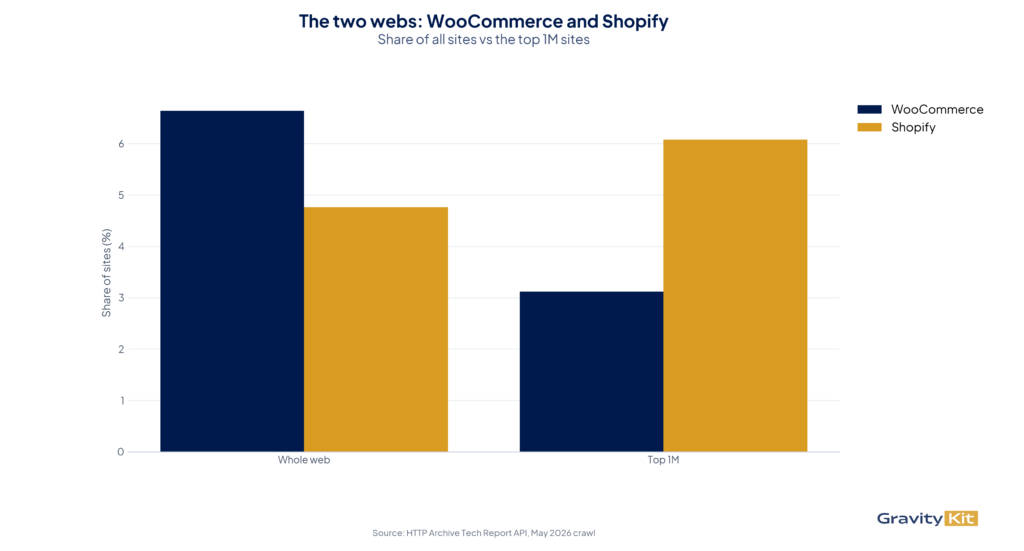
That whole-web ranking does not hold everywhere, though. Among the world’s most-visited sites, the order flips. We come back to that below.
Top ecommerce platforms by share
The table shows each platform two ways: as a share of the whole measurable web, and as a share of the named ecommerce platforms in this set (see methodology for both denominators).
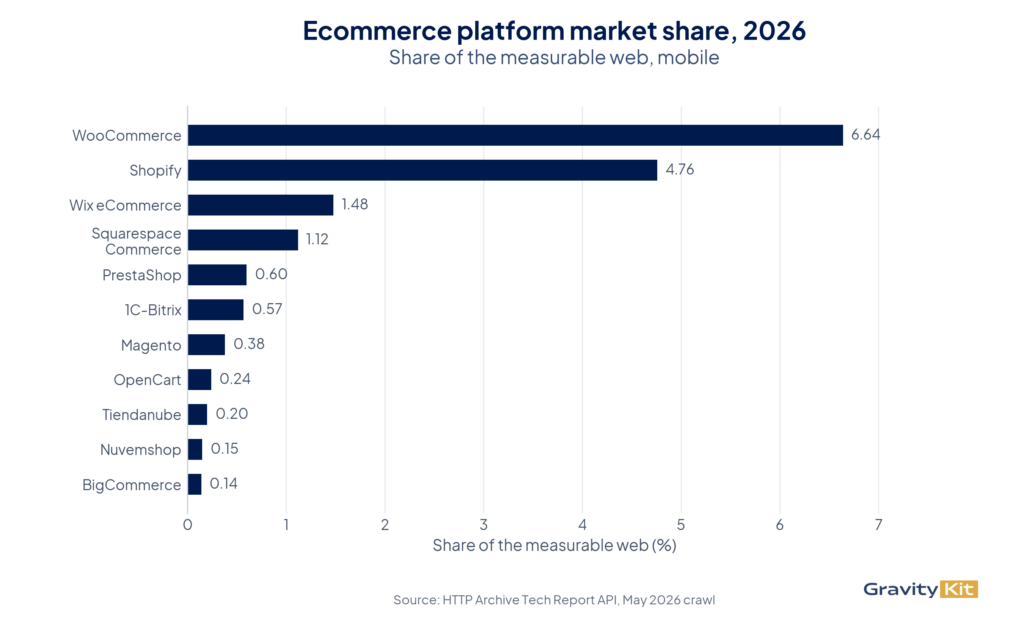
| Rank | Platform | Share of the measurable web | Share of named platforms |
|---|---|---|---|
| 1 | WooCommerce | 6.64% | 39.0% |
| 2 | Shopify | 4.76% | 27.9% |
| 3 | Wix eCommerce | 1.48% | 8.7% |
| 4 | Squarespace Commerce | 1.12% | 6.6% |
| 5 | PrestaShop | 0.60% | 3.5% |
| 6 | 1C-Bitrix | 0.57% | 3.4% |
| 7 | Magento / Adobe Commerce | 0.38% | 2.2% |
| 8 | OpenCart | 0.24% | 1.4% |
| 9 | Tiendanube | 0.20% | 1.2% |
| 10 | Nuvemshop | 0.15% | 0.9% |
| 11 | BigCommerce | 0.14% | 0.8% |
A long tail of smaller, mostly regional platforms rounds out the field, including Shoptet, Square Online, Salla, Cafe24, Shopline, Shopware, and Ecwid, each around 0.1% of the web or less.
The two webs: whole web vs the top 1M
On the whole web, WooCommerce leads Shopify by a factor of 1.40x (6.64% vs 4.76%). Narrow the sample to the most popular sites (HTTP Archive’s top-1M popularity tier from the Chrome UX Report) and the order reverses: Shopify holds 6.08% and WooCommerce 3.12%, a Shopify lead of about 1.95x.
A closer look at WooCommerce and Shopify
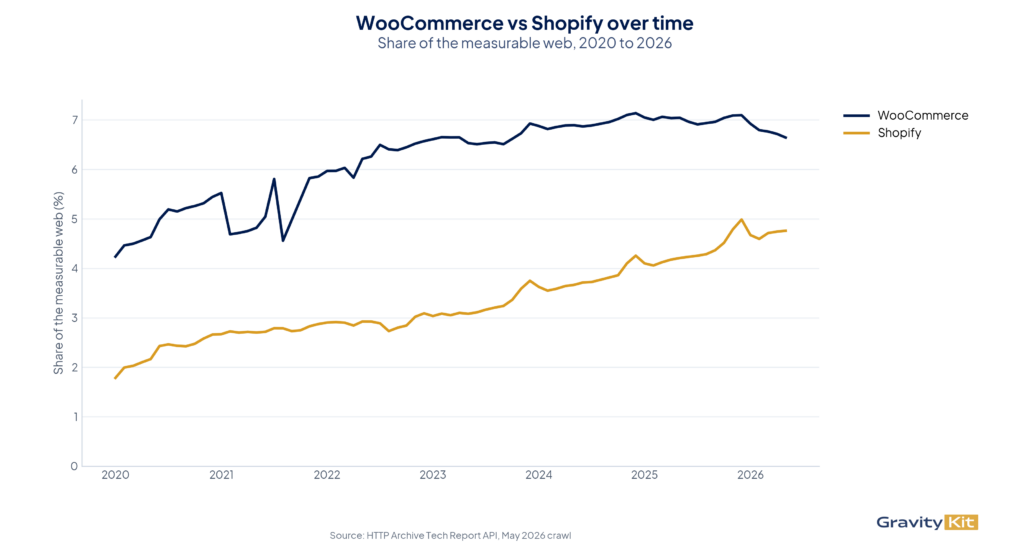
Over the 2020 to 2026 window, WooCommerce’s share of the measurable web climbed to a plateau above 7% and has edged down over the most recent months. Shopify’s share rose steadily over the same period, from about 1.8% in early 2020 to 4.76% today.
The rest of the field over time
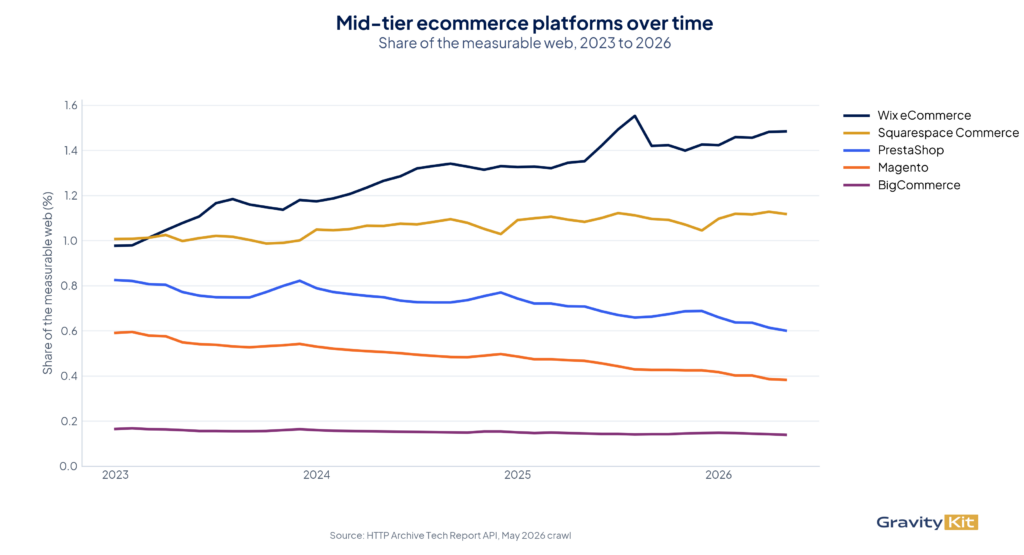
Among the mid-tier platforms, the movements since 2023 split in two directions. Wix eCommerce rose from about 1.0% to 1.48% of the web, and Squarespace Commerce edged up. PrestaShop fell from about 0.82% to 0.60%, Magento from about 0.59% to 0.38%, and BigCommerce edged down from about 0.17% to 0.14%.
Which platforms grew and shrank
Measured by year-over-year change in detected origins (May 2025 to May 2026), among the largest platforms Shopify grew fastest at +11.7%. Wix eCommerce grew 8.4% and Squarespace Commerce 2.0%. Every other large platform lost origins over the year: WooCommerce −6.8%, 1C-Bitrix −11.6%, PrestaShop −16.1%, and Magento −19.0%.
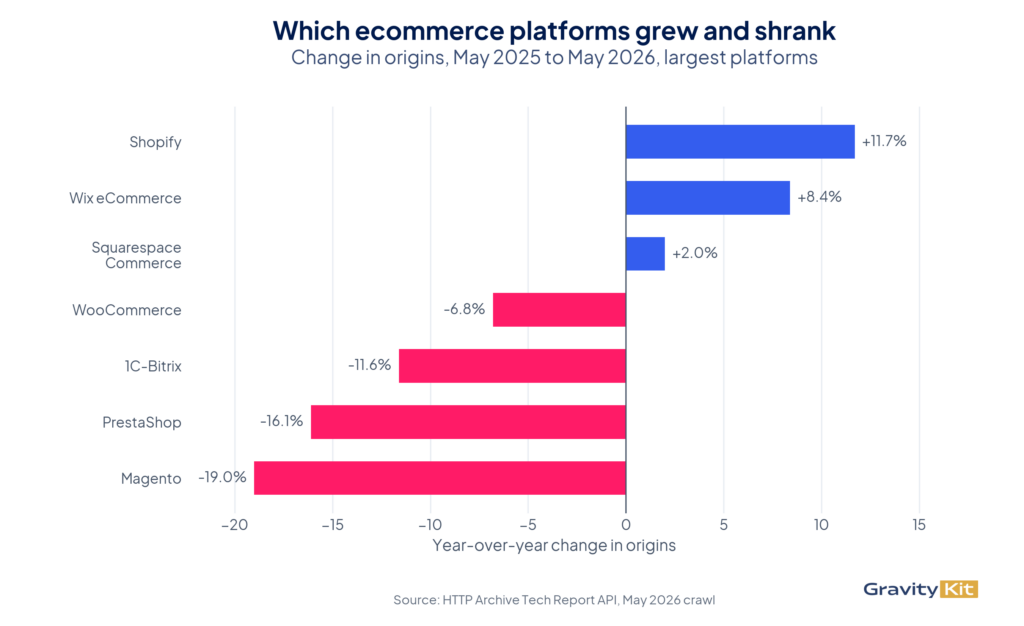
Among the largest platforms, Shopify is the only one growing at scale. The other year-over-year gainers are smaller, mostly regional platforms.
How much of the web is a store
Beyond the named platforms, HTTP Archive detects generic cart or checkout functionality on 20.2% of all measurable sites, so roughly one in five sites has some form of store. This is a broad signal that overlaps the platforms above: a WooCommerce or Shopify store is also counted here. For that reason we report it on its own, and never use it as a share denominator.
How we measured, and an important caveat
The HTTP Archive is not a census of every store. It measures sites in the Chrome User Experience Report, so very low-traffic and private sites are excluded, and it depends on platform fingerprints, so a newer or obscure platform can be undercounted. We think a single transparent method is the right call for a study like this, but it measures a defined sample, not the entire internet.
Methodology
- Data source – HTTP Archive Tech Report API, May 2026 crawl.
- Sample – Mobile origins in the Chrome User Experience Report (CrUX), roughly 8.9 million sites worldwide with enough Chrome traffic to be statistically measured.
- Detection – HTTP Archive’s Wappalyzer fork, Ecommerce category, detection on each origin’s homepage.
- YoY comparisons – May 2026 vs. May 2025 mobile origin counts.
- Share calculations – Two denominators. Share of the measurable web is a platform’s mobile origin count divided by
technology=ALLmobile origins for the same month. Share of named platforms is a platform’s mobile origins divided by the sum of the named ecommerce platforms in this study, same month. - Cart functionality – Reported separately as the share of sites with any detected cart or checkout. It overlaps the named platforms and is never used as a denominator.
- Chart cleaning – A few documented detection-glitch months are interpolated in the time-series charts only: WooCommerce’s Sept and Oct 2021 readings (which briefly collapsed to near zero) and an Aug 2024 mobile-crawl dip.
- Amazon Webstore – Counted in the denominators (real detected traffic, about 0.15% of the web) but excluded from the platform rankings as a detection artifact: Amazon discontinued the product, so those are legacy sites rather than a live platform.
- Detection granularity – Wix eCommerce and Squarespace Commerce are detected at the platform level rather than the store level, so both figures likely overstate active stores. Treat them as upper bounds.
- pp – Percentage points. A change from 4.20% to 4.76% is +0.56 pp.
We refresh these numbers quarterly. To catch the next quarterly update, subscribe to the GravityKit newsletter.

Get better at Gravity Forms, one email a week
New GravityKit releases, practical Gravity Forms tutorials, and subscriber-only discounts. One short email every week, unsubscribe anytime.
More articles

How to migrate from WPForms to Gravity Forms without rebuilding your forms
Move your WPForms forms into Gravity Forms with GravityMigrate, keeping their fields, conditional logic, confirmations, and notifications. Then bring your entries across with GravityImport.

Launch Log: Search Everything matches what fields show, steadier map searches, and security updates
GravityView’s Search Everything now matches the names fields display, and GravityView, Maps, GravityCalendar, and Dynamic Lookup get important security fixes.

How to build a WordPress client portal with Gravity Forms
Build a client portal on WordPress where each client logs in to see their profile, their requests, and the documents they’ve shared, using Gravity Forms and GravityView.