
Published
•
Updated
GravityView GitHub access: Changes we’re making and why
We’re making a small but important change to how the GravityView source code is distributed on GitHub. The GravityView core repository will move from public to private. This change is about aligning source access with licensed usage while continuing to fully support developers, agencies, and partners who build with GravityView. We want to emphasize that…

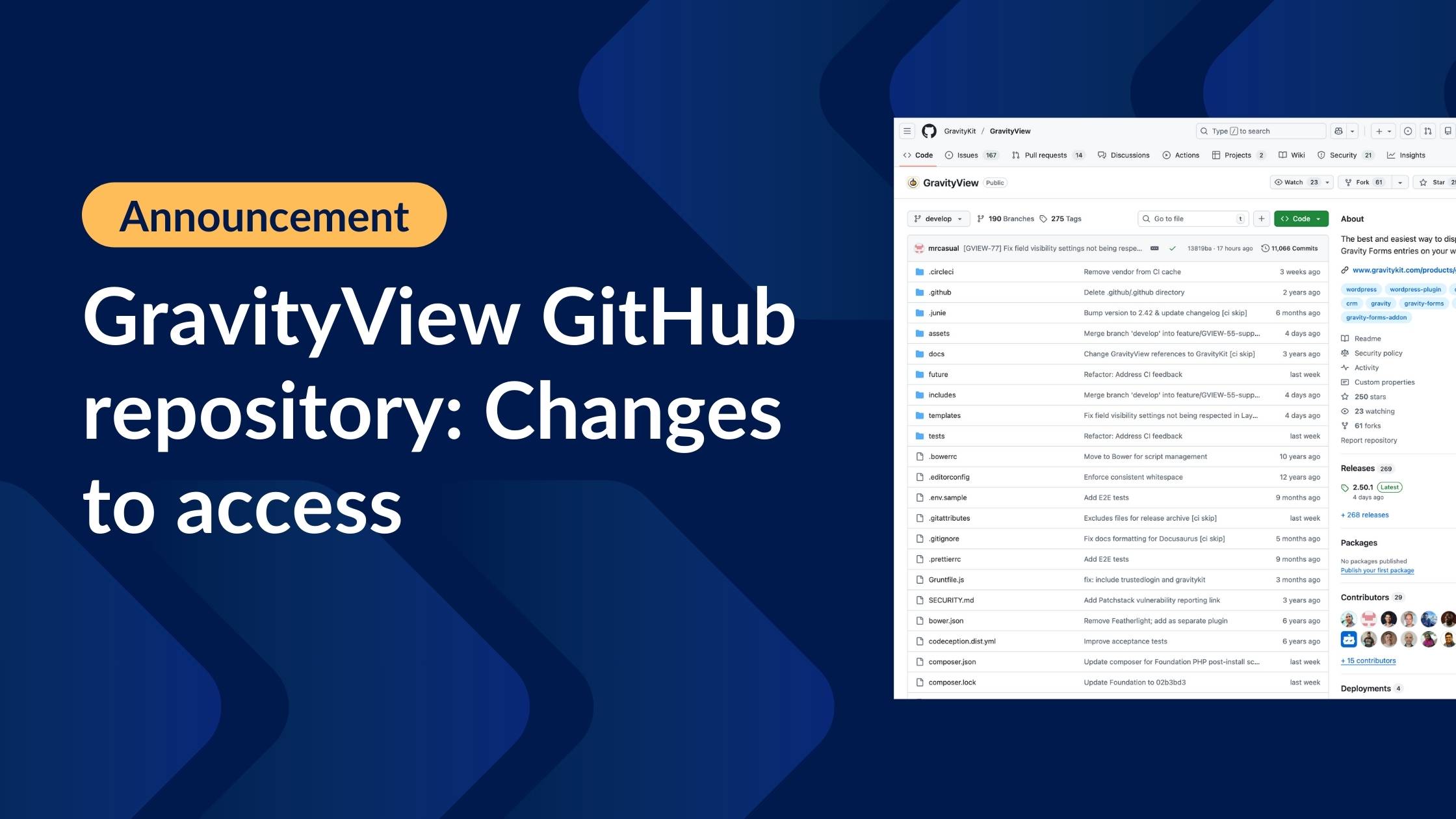
We’re making a small but important change to how the GravityView source code is distributed on GitHub.
The GravityView core repository will move from public to private. This change is about aligning source access with licensed usage while continuing to fully support developers, agencies, and partners who build with GravityView.
We want to emphasize that nothing is being taken away from paying customers with this change. If you’ve never used the GitHub repository directly, this change will have no impact on you.
Why we’re making this change
GravityView is a professional product that requires ongoing development, maintenance, and support. Over time, unrestricted public access to the full source code has made it harder to:
- Encourage sustainable licensing
- Provide consistent, high-quality support
- Clearly distinguish between licensed and unlicensed usage
By making the repository private, we can better align GitHub access with active licenses while keeping developer resources open and accessible.
What’s changing
- The GravityView core GitHub repository will no longer be publicly visible.
- Direct GitHub access to the core repository will only be available to eligible customers.
What’s not changing
All customers will continue to receive the full GravityView plugin, with updates distributed through gravitykit.com just as they are today. GravityView remains fully extensible.
Public developer resources also remain available:
- Comprehensive reference for hooks and filters: gravitykit.dev.
- Plugin documentation: https://www.gravitykit.com/docs/.
- Expert support with fast response times
GitHub access for customers
Customers with an active GravityView Pro license or All Access Pass can request access to the private GravityView GitHub repository. This includes individual developers, agencies, and teams working on client sites.
How to request access
Contact GravityKit support and include:
- The email address on your license (or order number)
- Your GitHub username
- Any additional GitHub usernames for your team
After verification, we’ll add the requested accounts to our GitHub access team.
For agencies and development teams
We understand that agencies and teams often need multiple developers to review or work with the source.
- Multiple named GitHub accounts can be granted access under a single eligible license
- GravityView Pro licenses include access for up to 5 GitHub accounts
- All Access Pass licenses include access for up to 15 GitHub accounts
Access is tied to active team members and can be updated as your team changes. Our goal is to support real-world development workflows without introducing unnecessary friction.
What this means for you
This change is not about locking down GravityView or limiting legitimate use.
It’s an important step to ensure GravityView remains sustainable, well-supported, and easy to build on for the long term.
Keeping the core repository public made it increasingly difficult to clearly separate licensed usage from unlicensed usage, which directly affects our ability to invest in:
- Ongoing development and new features
- Careful testing and compatibility with Gravity Forms updates
- Responsive, high-quality support for paying customers
By aligning GitHub access with active licenses, we can continue improving GravityView while still giving developers and agencies the access they need to understand, extend, and integrate with the plugin.
Just as importantly, this change reduces confusion around where to get support, how to report issues, and which resources are official and up to date.
If you have questions or concerns, please reach out. We’re happy to talk through how this change affects your workflow and make sure you have what you need to keep building with confidence.
FAQ
Do I need GitHub access to use GravityView?
No. GitHub access is not required to use GravityView, receive updates, or get support. Requesting GitHub access is optional and intended for agencies, developers, or customers who want full access to the source code to review or contribute to the plugin.
Which licenses include GitHub access?
Customers with an active GravityView Pro license or an All Access Pass are eligible to request GitHub access.
I’m an agency — can my whole team get access?
Yes. Agencies and teams can request access for multiple developers working under a single eligible license.
Where do I find hooks and filters now?
Our complete hooks and filters reference remains publicly available at gravitykit.dev.
Can I still review the source code for debugging?
Yes. Eligible customers can request GitHub access to review the source code. All customers can continue to inspect the plugin code locally as distributed.
Can I submit pull requests or contribute fixes?
We welcome contributions from licensed developers. If you’re interested in contributing, please contact support so we can coordinate the best path forward.
Why not keep the GravityView GitHub public and open for contributions?
In practice, GravityView has had very few direct code contributions (only one, to be exact) and a small number of bug reports through GitHub over the past two years.
As the product has matured, we’ve found that contributions and technical collaboration are more effective when handled through granted access and direct communication. This allows us to collaborate more closely, provide better context, and ensure changes align with GravityView’s roadmap, quality standards, and support commitments.
Is GravityView still open source and GPL‑compliant?
Yes. GravityView is licensed under the GPL and remains fully GPL‑compliant.
The GPL does not require that source code be publicly available to everyone at all times. It requires that customers who receive the software also receive the corresponding source code and the rights granted by the GPL. GravityView continues to meet those requirements.
All customers receive the full source code with the plugin as distributed through our official website, and eligible customers can request GitHub access for convenience and collaboration.
Is this a sign GravityView is moving away from developers?
No. Developers remain a core part of the GravityView ecosystem. Public documentation, hooks references, and developer support remain a priority, and licensed developers and agencies can request GitHub access by contacting GravityKit support with their license email and GitHub username(s).
What does this mean for the long-term future of GravityView?
This change helps support what you expect from GravityKit: thoughtful improvements, thorough testing, clear documentation, and responsive support. GravityView remains a reliable, professional solution that you can confidently build on for years to come.
Helpful tips right in your inbox.
Subscribe to get the latest articles, information on releases and helpful Gravity Forms tips!
More articles
Launch Log: theme template editing in Block MCP, Shield silentCAPTCHA for Zero Spam, and GravityView fixes
Block MCP adds safe theme template editing, Gravity Forms Zero Spam gains Shield silentCAPTCHA support, and GravityView fixes lightbox and notice bugs.
GravityKit turns 12: a year in review, and 30% off Lifetime All Access
GravityKit turns 12. A look back at a year of GravityView 3.0, GravitySearch, and AI-assisted building, plus a birthday sale on the Lifetime All Access Pass.
Launch Log: Row headers for screen readers, smarter conditional logic, and multi-View fixes
GravityView 3.1 adds row headers for screen readers, plus smarter conditional logic in GravityCalendar and fixes for DataTables, Maps, and Dynamic Lookup.