
Published
•
Updated
Announcing GravityCharts 1.14: Powerful new grouping options and enhanced performance
GravityCharts 1.14 adds flexible aggregate grouping for non-date fields, letting you chart totals or averages by category, product, or campaign without writing code.


We’re excited to announce the release of GravityCharts 1.14. This update provides more flexibility with powerful new grouping options, enhanced performance for larger datasets, and support for min and max values.
Let’s dive in!
Powerful new grouping options (aggregates)
Aggregates allow you to group entries by a specific field value and chart numerical data for those groups. Previously, this was only supported for date values, enabling you to chart values over time (by day, week, month, quarter, or year).
Now, aggregates are no longer tied to timeline charts—meaning you can group data by other fields as well, not just dates.
This enables powerful new use cases! For example, you could chart the total sum of sales per product category, or the average donation per campaign.
Here’s an example to illustrate how this works:
- Data Type: Select “By Field” to group data by a field option, rather than a date value.
- Data Source: Choose a field with multiple options to chart on the x-axis (for example, a Drop Down or Radio Buttons field).
- Data Operation: Select the operation to perform. If you select min, max, average, or sum, you’ll need to choose a numerical field to chart on the y-axis.
- Data Field: Choose a numerical field to chart on the y-axis.
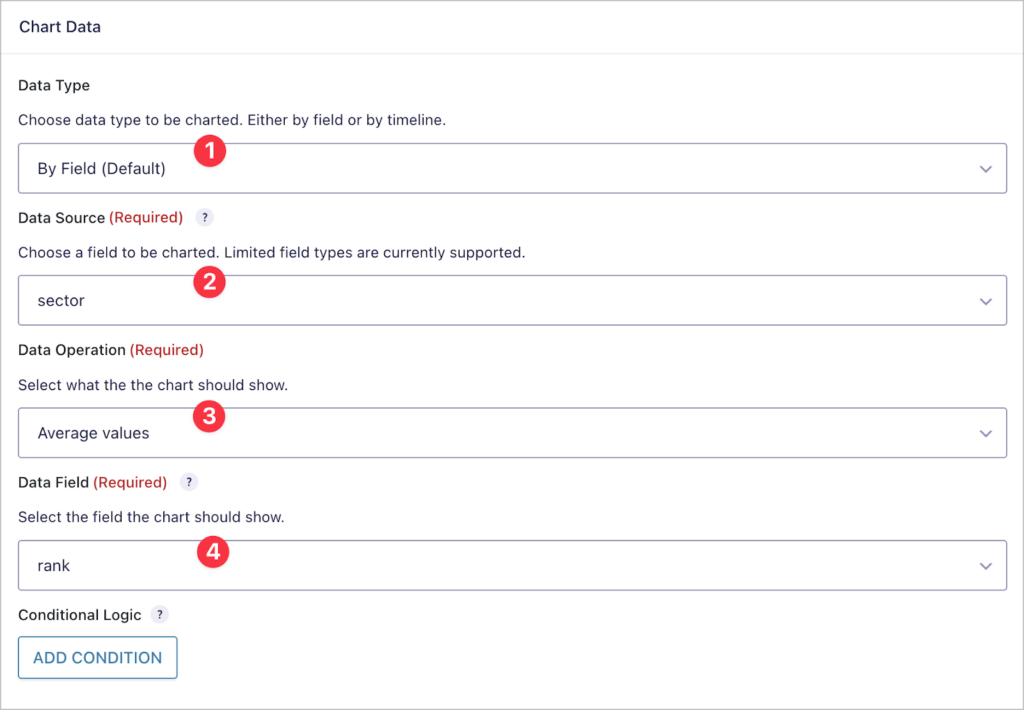
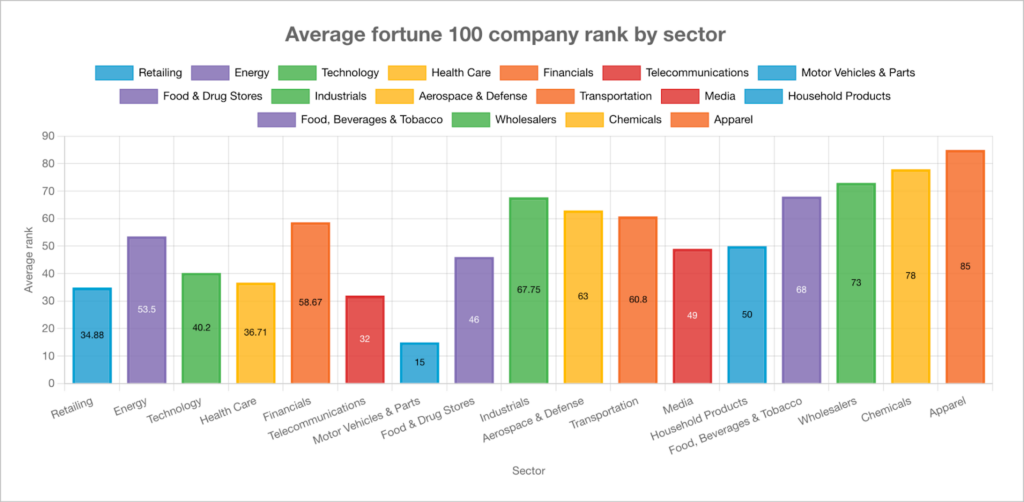
So in this example, we’re charting the average Fortune 100 company rank (y-axis) by sector (x-axis).
Support for min and max values
You can now chart the minimum and maximum values for a dataset—perfect for tracking highs and lows alongside existing totals, averages, and counts. Here’s a full list of supported operations:
- Entry count
- Sum values
- Maximum value
- Minimum value
- Average values
Performance enhancements
We’ve completely reworked how aggregate values are calculated—and the results speak for themselves.
Rather than processing entries one by one, GravityCharts now queries data directly from the database, delivering results faster and more efficiently, especially on large forms.
Translation? Your charts load quicker and your insights come faster!
All new developer hooks
We also added several new developer hooks, enabling you to customize field labels, values, the number of decimals places, and more. If you’re a developer, you can take a look at the changelog for more detailed information.
Update GravityCharts today
GravityCharts 1.14 introduces powerful new features such as field grouping, support for minimum and maximum values, blazing fast performance, and new developer hooks for customizing charts even further.
Update GravityCharts today from the “Manage Your Kit” page in WordPress to start building faster, smarter, and more insightful charts.

Get better at Gravity Forms, one email a week
New GravityKit releases, practical Gravity Forms tutorials, and subscriber-only discounts. One short email every week, unsubscribe anytime.
More articles

GravityMigrate 2.0: No-sweat WordPress form plugin migrations
Nobody wants to move forms between plugins. They want the site launched, the client onboarded, the referrals to stop falling through the cracks. GravityMigrate 2.0 makes moving forms effortless.

Launch Log: Two-way form migrations, a modernized chart block, and tighter board permissions
GravityMigrate 2.0.0 moves forms between Gravity Forms and seven other form plugins, GravityCharts modernizes its block in the WordPress editor, and GravityBoard tightens how board permissions are enforced.

9 ways to automate client work with the GravityKit MCP
Nine client jobs you can hand to the free GravityKit MCP, from auditing broken Views to cloning a finished build. Every one verified on a live site.